
diff options
| author | Krasimir Angelov <kr.angelov@gmail.com> | 2018-06-16 07:09:17 +0200 |
|---|---|---|
| committer | Krasimir Angelov <kr.angelov@gmail.com> | 2018-06-16 07:09:17 +0200 |
| commit | 96f3484622866c156045bd1a03bb6145d2c06ba6 (patch) | |
| tree | 740d0c673d38a789ba4ea3936432f81f6ec98d6a /src | |
| parent | 10e10298d9716c35080c16887a3d50ac4668916a (diff) | |
| parent | 9d2b92dbc1d9e221ce180497cd7d04e0757650a9 (diff) | |
Merge branch 'master' of https://github.com/GrammaticalFramework/GF
Diffstat (limited to 'src')
| -rw-r--r-- | src/compiler/GF/Text/Transliterations.hs | 8 | ||||
| -rw-r--r-- | src/runtime/typescript/gflib.d.ts | 337 | ||||
| -rw-r--r-- | src/tools/gf-tools.cabal | 21 | ||||
| -rw-r--r-- | src/tools/gf.el | 1351 | ||||
| -rw-r--r-- | src/tools/gftest/EqRel.hs | 32 | ||||
| -rw-r--r-- | src/tools/gftest/FMap.hs | 62 | ||||
| -rw-r--r-- | src/tools/gftest/Grammar.hs | 1121 | ||||
| -rw-r--r-- | src/tools/gftest/Graph.hs | 193 | ||||
| -rw-r--r-- | src/tools/gftest/Main.hs | 447 | ||||
| -rw-r--r-- | src/tools/gftest/Mu.hs | 113 | ||||
| -rw-r--r-- | src/tools/gftest/README.md | 564 |
11 files changed, 348 insertions, 3901 deletions
diff --git a/src/compiler/GF/Text/Transliterations.hs b/src/compiler/GF/Text/Transliterations.hs index 7645fc158..9b1b6e151 100644 --- a/src/compiler/GF/Text/Transliterations.hs +++ b/src/compiler/GF/Text/Transliterations.hs @@ -39,6 +39,7 @@ allTransliterations = Map.fromList [ ("amharic",transAmharic), ("ancientgreek", transAncientGreek), ("arabic", transArabic), + ("arabic_unvocalized", transArabicUnvoc), ("devanagari", transDevanagari), ("greek", transGreek), ("hebrew", transHebrew), @@ -178,6 +179,13 @@ transArabic = mkTransliteration "Arabic" allTrans allCodes where allCodes = [0x0621..0x062f] ++ [0x0630..0x063a] ++ [0x0641..0x064f] ++ [0x0650..0x0657] ++ [0x0671,0x061f] + +transArabicUnvoc :: Transliteration +transArabicUnvoc = transArabic{ + invisible_chars = ["a","u","i","v2","o","V+","V-","a:"], + printname = "unvocalized Arabic" + } + transPersian :: Transliteration transPersian = (mkTransliteration "Persian/Farsi" allTrans allCodes) {invisible_chars = ["a","u","i"]} where diff --git a/src/runtime/typescript/gflib.d.ts b/src/runtime/typescript/gflib.d.ts new file mode 100644 index 000000000..4249e66d2 --- /dev/null +++ b/src/runtime/typescript/gflib.d.ts @@ -0,0 +1,337 @@ +/** + * gflib.dt.s + * + * by John J. Camilleri + * + * TypeScript type definitions for the "original" JS GF runtime (GF:src/runtime/javascript/gflib.js) + */ + +// Note: the String prototype is extended with: +// String.prototype.tag = ""; +// String.prototype.setTag = function (tag) { this.tag = tag; }; + +/** + * A GF grammar is one abstract and multiple concretes + */ +declare class GFGrammar { + abstract: GFAbstract + concretes: {[key: string]: GFConcrete} + + constructor(abstract: GFAbstract, concretes: {[key: string]: GFConcrete}) + + translate( + input: string, + fromLang: string, + toLang: string + ): {[key: string]: {[key: string]: string}} +} + +/** + * Abstract Syntax Tree + */ +declare class Fun { + name: string + args: Fun[] + + constructor(name: string, ...args: Fun[]) + + print(): string + show(): string + getArg(i: number): Fun + setArg(i: number, c: Fun): void + isMeta(): boolean + isComplete(): boolean + isLiteral(): boolean + isString(): boolean + isInt(): boolean + isFloat(): boolean + isEqual(obj: any): boolean +} + +/** + * Abstract syntax + */ +declare class GFAbstract { + startcat: string + types: {[key: string]: Type} // key is function name + + constructor(startcat: string, types: {[key: string]: Type}) + + addType(fun: string, args: string[], cat: string): void + getArgs(fun: string): string[] + getCat(fun: string): string + annotate(tree: Fun, type: string): Fun + handleLiterals(tree: Fun, type: Type): Fun + copyTree(x: Fun): Fun + parseTree(str: string, type: string): Fun + parseTree_(tokens: string[], prec: number): Fun +} + +/** + * Type + */ +declare class Type { + args: string[] + cat: string + + constructor(args: string[], cat: string) +} + +type ApplyOrCoerce = Apply | Coerce + +/** + * Concrete syntax + */ +declare class GFConcrete { + flags: {[key: string]: string} + productions: {[key: number]: ApplyOrCoerce[]} + functions: CncFun[] + sequences: Array<Array<Sym>> + startCats: {[key: string]: {s: number, e: number}} + totalFIds: number + pproductions: {[key: number]: ApplyOrCoerce[]} + lproductions: {[key: string]: {fid: FId, fun: CncFun}} + + constructor( + flags: {[key: string]: string}, + productions: {[key: number]: ApplyOrCoerce[]}, + functions: CncFun[], + sequences: Array<Array<Sym>>, + startCats: {[key: string]: {s: number, e: number}}, + totalFIds: number + ) + + linearizeSyms(tree: Fun, tag: string): Array<{fid: FId, table: any}> + syms2toks(syms: Sym[]): string[] + linearizeAll(tree: Fun): string[] + linearize(tree: Fun): string + tagAndLinearize(tree: Fun): string[] + unlex(ts: string): string + tagIt(obj: any, tag: string): any + // showRules(): string // Uncaught TypeError: Cannot read property 'length' of undefined at gflib.js:451 + tokenize(string: string): string[] + parseString(string: string, cat: string): Fun[] + complete( + input: string, + cat: string + ): {consumed: string[], suggestions: string[]} +} + +/** + * Function ID + */ +type FId = number + +/** + * Apply + */ +declare class Apply { + id: string + fun: FId + args: PArg[] + + constructor(fun: FId, args: PArg[]) + + show(cat: string): string + isEqual(obj: any): boolean +} + +/** + * PArg + */ +declare class PArg { + fid: FId + hypos: any[] + + constructor(fid: FId, ...hypos: any[]) +} + +/** + * Coerce + */ +declare class Coerce { + id: string + arg: FId + + constructor(arg: FId) + + show(cat: string): string +} + +/** + * Const + */ +declare class Const { + id: string + lit: Fun + toks: any[] + + constructor(lit: Fun, toks: any[]) + + show(cat: string): string + isEqual(obj: any): boolean +} + +/** + * CncFun + */ +declare class CncFun { + name: string + lins: FId[] + + constructor(name: string, lins: FId[]) +} + +type Sym = SymCat | SymKS | SymKP | SymLit + +/** + * SymCat + */ +declare class SymCat { + id: string + i: number + label: number + + constructor(i: number, label: number) + + getId(): string + getArgNum(): number + show(): string +} + +/** + * SymKS + */ +declare class SymKS { + id: string + tokens: string[] + + constructor(...tokens: string[]) + + getId(): string + show(): string +} + +/** + * SymKP + */ +declare class SymKP { + id: string + tokens: string[] + alts: Alt[] + + constructor(tokens: string[], alts: Alt[]) + + getId(): string + show(): string +} + +/** + * Alt + */ +declare class Alt { + tokens: string[] + prefixes: string[] + + constructor(tokens: string[], prefixes: string[]) +} + +/** + * SymLit + */ +declare class SymLit { + id: string + i: number + label: number + + constructor(i: number, label: number) + + getId(): string + show(): string +} + +/** + * Trie + */ +declare class Trie { + value: any + items: Trie[] + + insertChain(keys, obj): void + insertChain1(keys, obj): void + lookup(key, obj): any + isEmpty(): boolean +} + +/** + * ParseState + */ +declare class ParseState { + concrete: GFConcrete + startCat: string + items: Trie + chart: Chart + + constructor(concrete: GFConcrete, startCat: string) + + next(token: string): boolean + complete(correntToken: string): Trie + extractTrees(): any[] + process( + agenda, + literalCallback: (fid: FId) => any, + tokenCallback: (tokens: string[], item: any) => any + ): void +} + +/** + * Chart + */ +declare class Chart { + active: any + actives: {[key: number]: any} + passive: any + forest: {[key: number]: ApplyOrCoerce[]} + nextId: number + offset: number + + constructor(concrete: GFConcrete) + + lookupAC(fid: FId,label) + lookupACo(offset, fid: FId, label) + + labelsAC(fid: FId) + insertAC(fid: FId, label, items): void + + lookupPC(fid: FId, label, offset) + insertPC(fid1: FId, label, offset, fid2: FId): void + shift(): void + expandForest(fid: FId): any[] +} + +/** + * ActiveItem + */ +declare class ActiveItem { + offset: number + dot: number + fun: CncFun + seq: Array<Sym> + args: PArg[] + fid: FId + lbl: number + + constructor( + offset: number, + dot: number, + fun: CncFun, + seq: Array<Sym>, + args: PArg[], + fid: FId, + lbl: number + ) + + isEqual(obj: any): boolean + shiftOverArg(i: number, fid: FId): ActiveItem + shiftOverTokn(): ActiveItem +} diff --git a/src/tools/gf-tools.cabal b/src/tools/gf-tools.cabal index 47ce0f01c..1f89f3a85 100644 --- a/src/tools/gf-tools.cabal +++ b/src/tools/gf-tools.cabal @@ -9,23 +9,4 @@ Executable gfdoc Executable htmls main-is: Htmls.hs - build-depends: base - - -library - hs-source-dirs: gftest - exposed-modules: Grammar - other-modules: Mu, Graph, FMap, EqRel - build-depends: base - , containers - , pgf2 - -executable gftest - hs-source-dirs: gftest - main-is: Main.hs - build-depends: base - , pgf2 - , cmdargs - , containers - , filepath - , gf-tools
\ No newline at end of file + build-depends: base
\ No newline at end of file diff --git a/src/tools/gf.el b/src/tools/gf.el index c8ebc9a50..594e0845e 100644 --- a/src/tools/gf.el +++ b/src/tools/gf.el @@ -1,1350 +1 @@ -;;; gf.el --- Major mode for editing GF code -*-coding: iso-8859-1;-*- - -;; Copyright (C) 2005, 2006, 2007 Johan Bockgård -;; Time-stamp: <2007-06-16 11:57:48 bojohan> - -;; Author: Johan Bockgård <bojohan+mail@dd.chalmers.se> -;; Keywords: languages - -;; This file is free software; you can redistribute it and/or modify -;; it under the terms of the GNU General Public License as published by -;; the Free Software Foundation; either version 2, or (at your option) -;; any later version. - -;; This file is distributed in the hope that it will be useful, -;; but WITHOUT ANY WARRANTY; without even the implied warranty of -;; MERCHANTABILITY or FITNESS FOR A PARTICULAR PURPOSE. See the -;; GNU General Public License for more details. - -;; You should have received a copy of the GNU General Public License -;; along with GNU Emacs; see the file COPYING. If not, write to -;; the Free Software Foundation, Inc., 51 Franklin Street, Fifth Floor, -;; Boston, MA 02110-1301, USA. - -;;; Commentary: - -;; Major mode for editing GF code, with support for running a GF -;; shell. - -;;; Usage: - -;; To use this library, put it somewhere Emacs can find it (in -;; `load-path') and add the following lines to your .emacs file. - -;; (autoload 'run-gf "gf" nil t) -;; (autoload 'gf-mode "gf" nil t) -;; (add-to-list 'auto-mode-alist '("\\.gf\\(\\|e\\|r\\|cm?\\)\\'" . gf-mode)) -;; (add-to-list 'auto-mode-alist '("\\.cf\\'" . gf-mode)) -;; (add-to-list 'auto-mode-alist '("\\.ebnf\\'" . gf-mode)) - -;;; History: - -;; 2006-10-30: -;; let a = b -;; c = d ... -;; in ... -;; indentation now works (most of the time). - -;;; Code: - -(eval-when-compile (require 'cl)) - -(defgroup gf nil - "Support for GF (Grammatical Framework)" - :group 'languages - ;; :link '(emacs-commentary-link "gf") - :link '(url-link "http://www.cs.chalmers.se/~aarne/GF/")) - -(defvar gf-mode-map - (let ((map (make-sparse-keymap))) - (define-key map "\C-c\C-l" 'gf-load-file) - (define-key map "\C-c\C-b" 'gf-display-inf-buffer) - (define-key map "\C-c\C-s" 'run-gf) - (define-key map (kbd "DEL") 'backward-delete-char-untabify) - map) - "Keymap for `gf-mode'.") - -;; Taken from haskell-mode -(defvar gf-mode-syntax-table - (let ((table (make-syntax-table))) - (modify-syntax-entry ?\ " " table) - (modify-syntax-entry ?\t " " table) - (modify-syntax-entry ?\" "\"" table) - (modify-syntax-entry ?\' "\'" table) - (modify-syntax-entry ?_ "w" table) - (modify-syntax-entry ?\( "()" table) - (modify-syntax-entry ?\) ")(" table) - (modify-syntax-entry ?\[ "(]" table) - (modify-syntax-entry ?\] ")[" table) - ;; (modify-syntax-entry ?\< "(>" table) - ;; (modify-syntax-entry ?\> ")<" table) - - (cond ((featurep 'xemacs) - ;; I don't know whether this is equivalent to the below - ;; (modulo nesting). -- fx - (modify-syntax-entry ?{ "(}5" table) - (modify-syntax-entry ?} "){8" table) - (modify-syntax-entry ?- "_ 1267" table)) - (t - ;; The following get comment syntax right, similarly to C++ - ;; In Emacs 21, the `n' indicates that they nest. - ;; The `b' annotation is actually ignored because it's only - ;; meaningful on the second char of a comment-starter, so - ;; on Emacs 20 and before we get wrong results. --Stef - (modify-syntax-entry ?\{ "(}1nb" table) - (modify-syntax-entry ?\} "){4nb" table) - (modify-syntax-entry ?- "_ 123" table))) - (modify-syntax-entry ?\n ">" table) - - (let (i lim) - (map-char-table - (lambda (k v) - (when (equal v '(1)) - ;; The current Emacs 22 codebase can pass either a char - ;; or a char range. - (if (consp k) - (setq i (car k) - lim (cdr k)) - (setq i k - lim k)) - (while (<= i lim) - (when (> i 127) - (modify-syntax-entry i "_" table)) - (setq i (1+ i))))) - (standard-syntax-table))) - - (modify-syntax-entry ?\` "$`" table) - (modify-syntax-entry ?\\ "\\" table) - (mapcar (lambda (x) - (modify-syntax-entry x "_" table)) - ;; Some of these are actually OK by default. - "!#$%&*+./:=?@^|~") - (unless (featurep 'mule) - ;; Non-ASCII syntax should be OK, at least in Emacs. - (mapcar (lambda (x) - (modify-syntax-entry x "_" table)) - (concat "¡¢£¤¥¦§¨©ª«¬®¯°±²³´µ¶·¸¹º»¼½¾¿" - "×÷")) - (mapcar (lambda (x) - (modify-syntax-entry x "w" table)) - (concat "ÀÁÂÃÄÅÆÇÈÉÊËÌÍÎÏÐÑÒÓÔÕÖ" - "ØÙÚÛÜÝÞß" - "àáâãäåæçèéêëìíîïðñòóôõö" - "øùúûüýþÿ"))) - table) - "Syntax table used in GF mode.") - -;; Lin PType Str Strs Tok Type -;; abstract case cat concrete data def -;; flags fn fun grammar in include -;; incomplete instance interface let lin lincat -;; lindef lintype of open oper out -;; package param pattern pre printname resource -;; reuse strs table tokenizer transfer union -;; var variants where with -;; ; = { } ( ) : -> ** , [ ] - . | % ? < > @ ! * \ => ++ + _ $ / - -;; Judgements -(defvar gf-top-level-keywords - '("cat" "fun" "lincat" "lintype" "lin" "pattern" - "oper" "def" "param" "flags" "lindef" "printname" - "data" "transfer" - )) - -(defvar gf-module-keywords - '("abstract" "concrete" "resource" "instance" "interface")) - -(defvar gf-keywords - (append '("of" "let" "include" "open" "in" "where" - "with" "case" "incomplete" "table" - "variants" "pre" "strs" "overload") - gf-top-level-keywords - gf-module-keywords)) - -(defvar gf-top-level-keyword-regexp (regexp-opt gf-top-level-keywords 'words)) -(defvar gf-keyword-regexp (regexp-opt gf-keywords 'words)) - -(defvar gf-font-lock-keywords - (let ((sym "\\(\\s_\\|\\\\\\)+") - ;; (keyw gf-keyword-regexp) - (mod (concat (regexp-opt gf-module-keywords 'words) - "\\s-\\(\\w+\\)")) - (pface '(if (boundp 'font-lock-preprocessor-face) - font-lock-preprocessor-face - font-lock-builtin-face))) - `(;; Module - (,mod (1 font-lock-keyword-face) - (2 font-lock-type-face)) - ;; Keywords - (,(lambda (end) - (let (parse-sexp-lookup-properties) - (re-search-forward gf-keyword-regexp end t))) - . font-lock-keyword-face) - ;; Operators - (,sym . font-lock-variable-name-face) - ;; Pragmas - ("^--\\(#.*\\)" (1 ,pface prepend)) - ("--\\(#\\s-*\\(notpresent\\|prob\\).*\\)" (1 ,pface prepend)) - ;; GFDoc - ("^--[0-9]+\\s-*\\(.*\\)" (1 'underline prepend)) - ("^--\\([*!.]\\)" (1 'underline prepend)) - (,(lambda (end) - (let (found) - (while - (and (setq found (re-search-forward - ;; "\\$.*?\\$\\|\\*.*?\\*\\|\".*?\"" - "\\$.*?\\$" - end t)) - (not (eq (get-text-property (match-beginning 0) 'face) - 'font-lock-comment-face)))) - found)) - (0 (if (face-italic-p 'font-lock-comment-face) - '((:slant normal)) - '((:slant italic))) - prepend)) - ;; Types (?) - ;; ("[^.]\\(\\<[[:upper:]]\\w*\\)[^.]" 1 font-lock-type-face) - )) - "Keyword highlighting specification for `gf-mode'.") - -(defcustom gf-let-brace-style t - "The let...in style to use for indentaton. - -A value of t means unbraced (new) style: - - - let x = a; - y = b; in ... - -A value of nil means braced (old) style - - let { x = a; - y = b; } in ... - -Anything else means try to guess." - :type '(choice (const :tag "Unbraced" t) - (const :tag "Braced" nil) - (const :tag "Heuristic" 'heuristic)) - :group 'gf) - -;; let x = let a = f; -;; b = g; -;; in b; -;; y = d; -;; in h -(defun gf-match-let/in (let/in end) - (when gf-let-brace-style - (if (eq 'let let/in) - (and (re-search-forward "\\<le\\(t\\)\\>" end t) - (or (eq t gf-let-brace-style) - (save-excursion - (skip-syntax-forward " ") - (not (eq ?\{ (char-after)))))) - (and (re-search-forward "\\<\\(i\\)n\\>" end t) - (or (eq t gf-let-brace-style) - (save-excursion - (backward-char 2) - (skip-syntax-backward " ") - (not (eq ?\} (char-before))))))))) - -(defvar gf-font-lock-syntactic-keywords - `(;; let ... - (,(lambda (end) (gf-match-let/in 'let end)) - 1 "(") - ;; ;; open ... - ;; (,(lambda (end) - ;; (and (re-search-forward "\\<ope\\(n\\)\\>" end t) - ;; (save-excursion - ;; (skip-syntax-forward " ") - ;; (not (eq ?\{ (char-after)))))) - ;; 1 "(") - ;; ... in - (,(lambda (end) (gf-match-let/in 'in end)) - 1 ")") - )) - - ;; (defvar gf-imenu-generic-expression - ;; ...) - - ;; (defvar gf-outline-regexp - ;; ...) - -;;;###autoload -(define-derived-mode gf-mode fundamental-mode "GF" - "A major mode for editing GF files." - ;; (set (make-local-variable 'imenu-generic-expression) - ;; gf-imenu-generic-expression) - ;; (set (make-local-variable 'outline-regexp) sample-outline-regexp) - (set (make-local-variable 'comment-start) "-- ") - (set (make-local-variable 'comment-start-skip) "[-{]-[ \t]*") - (set (make-local-variable 'font-lock-defaults) - '(gf-font-lock-keywords - nil nil nil nil - (font-lock-syntactic-keywords . gf-font-lock-syntactic-keywords) - )) - (set (make-local-variable 'indent-line-function) 'gf-indent-line) - (set (make-local-variable 'eldoc-documentation-function) 'gf-doc-display) - (set (make-local-variable 'beginning-of-defun-function) - 'gf-beginning-of-section) - (set (make-local-variable 'end-of-defun-function) - 'gf-end-of-section)) - -;;; Indentation -(defcustom gf-indent-basic-offset 2 - "*Number of columns to indent in GF mode." - :type 'integer - :group 'gf) - -(defcustom gf-indent-judgment-offset 2 - "*Column where judement should be indented to." - :type 'integer - :group 'gf) - -(defun gf-indent-line () - "Indent current line of GF code." - (interactive) - (save-excursion - (font-lock-fontify-syntactic-keywords-region - (point-at-bol) (point-at-bol))) - (let* ((case-fold-search nil) - (parse-sexp-lookup-properties t) - (parse-sexp-ignore-comments t) - (savep (> (current-column) (current-indentation))) - (indent (condition-case err - (max (gf-calculate-indentation) 0) - (error (message "%s" err) 0)))) - (if savep - (save-excursion (indent-line-to indent)) - (indent-line-to indent)))) - -(defun gf-beginning-of-section () - (when (re-search-backward - (concat "^\\s-*" gf-top-level-keyword-regexp) - nil 'move) - (goto-char (match-beginning 0))) - (point)) - -(defun gf-end-of-section () - (gf-forward-comment) - (when (looking-at gf-top-level-keyword-regexp) - (goto-char (match-end 0))) - (when (re-search-forward - (concat "^\\s-*" gf-top-level-keyword-regexp) - (condition-case nil - (1- (scan-lists (point) 1 1)) - (error nil)) - 'move) - (goto-char (match-beginning 0))) - (gf-backward-comment) - (point)) - -;; (defun gf-beginning-of-defun () -;; (let* ((beg (save-excursion (gf-beginning-of-section) (point))) -;; (end (save-excursion (progn (forward-line 0) (point)))) -;; (pps (parse-partial-sexp beg end))) -;; (when (nth 1 pps) (backward-up-list (nth 0 pps))) -;; (back-to-indentation) -;; (point))) - -(defun gf-beginning-of-sequence (&optional keep-going limit) - (or limit (let ((com-start (gf-in-comment-p))) - (when com-start - (save-excursion - (goto-char com-start) - (skip-chars-forward "{") - (skip-chars-forward "-") - (setq limit (point)))))) - (let* ((str "[;]") - (found-it nil) - (pps (gf-ppss)) - (depth (or (nth 0 pps) 0)) - (bol (point-at-bol)) - (lim (max (or limit (point-min)) - (if (nth 1 pps) - (1+ (nth 1 pps)) - (save-excursion - (gf-beginning-of-section) - (when (looking-at - (concat "\\s-*" gf-top-level-keyword-regexp)) - (goto-char (match-end 0)) - (gf-forward-comment)) - (point)))))) - (while (and (> (point) lim) - (setq found-it (re-search-backward str lim 'move)) - (let ((pps (gf-ppss))) - (or (/= depth (nth 0 pps)) - (nth 3 pps) - (nth 4 pps))))) - (when found-it - (when keep-going - (setq lim (max lim bol)) - (while (and (> (point) lim) - (setq found-it (re-search-backward str lim 'move)) - ;;(/= depth (nth 0 (gf-ppss))) - ))) - (when found-it (forward-char))))) - -(defun gf-in-comment-p () - (let ((pps (gf-ppss))) - (and (nth 4 pps) (nth 8 pps)))) - -(defun gf-forward-comment () (forward-comment (buffer-size))) -(defun gf-backward-comment () - (forward-comment (- (buffer-size))) - ;; (while (or (not (zerop (skip-chars-backward " \t\n"))) - ;; (let ((start (gf-in-comment))) - ;; (and start (goto-char start))))) - ) - - -(defun gf-ppss ();; (&optional from to) - (parse-partial-sexp - (save-excursion (gf-beginning-of-section)) - (point))) - -(if (fboundp 'syntax-after) - (defalias 'gf-syntax-after 'syntax-after) - (defun gf-syntax-after (pos) - "Return the raw syntax of the char after POS. -If POS is outside the buffer's accessible portion, return nil." - (unless (or (< pos (point-min)) (>= pos (point-max))) - (let ((st (if parse-sexp-lookup-properties - (get-char-property pos 'syntax-table)))) - (if (consp st) st - (aref (or st (syntax-table)) (char-after pos))))))) - -(if (fboundp 'syntax-class) - (defalias 'gf-syntax-class 'syntax-class) - (defun gf-syntax-class (syntax) - "Return the syntax class part of the syntax descriptor SYNTAX. -If SYNTAX is nil, return nil." - (and syntax (logand (car syntax) 65535)))) - -(defun gf-calculate-indentation () - "Return the column to which the current line should be indented." - (save-excursion - (forward-line 0) - (skip-chars-forward " \t") - (cond - ;; judgement - ((looking-at gf-top-level-keyword-regexp) - gf-indent-judgment-offset) - ((and gf-let-brace-style - (looking-at "in\\>")) - (if (condition-case nil - (progn (backward-up-list) - nil) - (error t)) - gf-indent-basic-offset - (gf-beginning-of-sequence) - (if (= (point) (point-min)) - 0 - (gf-forward-comment) - (+ gf-indent-basic-offset (current-column))))) - ((looking-at "[]})]") - ;; (looking-at "[]})]") - ;; (eq 5 (gf-syntax-class (gf-syntax-after (point)))) - (backward-up-list) - (gf-beginning-of-sequence) - (if (= (point) (point-min)) - 0 - (gf-forward-comment) - (+ gf-indent-basic-offset (current-column)))) - ;; heading - ((looking-at "---") - (gf-beginning-of-sequence) - (if (= (point) (point-min)) - 0 - gf-indent-judgment-offset)) - (t - (let ((opoint (point))) - (gf-backward-comment) - (cond - ((eq ?\; (char-before)) - ;; ?\, - (backward-char) - (gf-beginning-of-sequence t) - (gf-forward-comment) - (current-column)) - (;; (memq (char-before) '( ?\{ ?\[ ?\( ;; ?\< - ;; )) - (eq 4 (gf-syntax-class (gf-syntax-after (1- (point))))) - (backward-char) - ;; alt. (gf-beginning-of-sequence nil nil) - (gf-beginning-of-sequence nil (point-at-bol)) - (gf-forward-comment) - ;; alt. (+ (* 2 gf-indent-basic-offset) (current-column))) - (+ gf-indent-basic-offset (current-column))) - (t - (gf-beginning-of-sequence) - (let ((head (= (point) (point-min)))) - (gf-forward-comment) - (cond - ;; ((< opoint (point)) 0) - ((> opoint (point)) (+ gf-indent-basic-offset (current-column))) - ;; i.e. opoint == (point) - (head 0) - (t (gf-beginning-of-section) - (skip-chars-forward " \t") - (+ gf-indent-basic-offset (current-column)))))))))))) - -(defun gf-load-file () - (interactive) - (start-gf) - (comint-send-string gf-process (format "i %s\n" buffer-file-name)) - (gf-clear-lang-cache) - (gf-display-inf-buffer)) - -(defun gf-display-inf-buffer () - (interactive) - (and (get-buffer gf-process-buffer-name) - (display-buffer gf-process-buffer-name))) - -;; Inferior GF Mode ---------------- - -(defcustom gf-program-name "gf" - "*Name of GF shell invoked by `run-gf'." - :type 'file - :group 'gf) -(defvar gf-program-args nil "*Arguments passed to GF by `run-gf'.") -(defvar gf-process-buffer-name "*gf*") -(defvar gf-process) - -(require 'comint) - -(define-derived-mode inf-gf-mode comint-mode "Inf-GF" - (gf-setup-pcomplete)) - -(define-key inf-gf-mode-map "\t" 'gf-complete) - -;;;###autoload -(defun run-gf () - "Run an inferior GF process." - (interactive) - (start-gf) - (pop-to-buffer gf-process-buffer-name)) - -(defun start-gf () - (unless (comint-check-proc gf-process-buffer-name) - (with-current-buffer - (apply 'make-comint-in-buffer - "gf" gf-process-buffer-name gf-program-name - nil gf-program-args) - (setq gf-process (get-buffer-process (current-buffer))) - (set-buffer-process-coding-system 'latin-1-unix 'latin-1-unix) - (inf-gf-mode)))) - -;; (defun gf-norm-func (string) -;; (if (string-match "\\(.*\\)\\(=[^=]*\\)" string) -;; (match-string 1 string) -;; string)) - -;; (defmacro gf-pcomplete-here (&optional form stub paring form-only) -;; `(pcomplete-here ,form ,stub (or ,paring 'gf-norm-func) ,form-only)) -;; (put 'gf-pcomplete-here 'edebug-form-spec t) - -(put 'pcomplete-here 'edebug-form-spec t) - -(defun gf-setup-pcomplete () - (set (make-local-variable 'comint-prompt-regexp) "^[^>\n]*> *") - (set (make-local-variable 'pcomplete-ignore-case) nil) - (set (make-local-variable 'pcomplete-use-paring) t) - (set (make-local-variable 'pcomplete-suffix-list) '(?/ ?=)) - ;; (set (make-local-variable 'comint-dynamic-complete-functions) - ;; (add-to-list 'comint-dynamic-complete-functions 'pcomplete)) - (set (make-local-variable 'pcomplete-parse-arguments-function) - 'gf-parse-arguments) - (set (make-local-variable 'pcomplete-command-completion-function) - 'gf-complete-command) - ;; (set (make-local-variable 'pcomplete-command-name-function) - ;; 'pcomplete-erc-command-name) - (set (make-local-variable 'pcomplete-default-completion-function) - 'gf-default-completion-function) - (add-hook 'comint-input-filter-functions - 'gf-watch-for-loading - nil t)) - -(defun gf-watch-for-loading (string) - (when (string-match (concat "\\(\\`\\||\\;;\\)\\s-*" - (regexp-opt '("i" "e" "rl") 'words)) - string) - (gf-clear-lang-cache))) - -(defun gf-parse-arguments () - "Parse whitespace separated arguments in the current region." - (let ((begin (save-excursion - ;; (parse-partial-sexp begin end) - (if (re-search-backward "|\\|;;" (point-at-bol) t) - (match-end 0) - (comint-bol nil) - (point)))) - (end (point)) - begins args) - (save-excursion - (goto-char begin) - (while (< (point) end) - (skip-chars-forward " \t\n") - (setq begins (cons (point) begins)) - (let ((skip t)) - (while skip - (skip-chars-forward "^ \t\n") - (if (eq (char-before) ?\\) - (skip-chars-forward " \t\n") - (setq skip nil)))) - (setq args (cons (buffer-substring-no-properties - (car begins) (point)) - args))) - (cons (reverse args) (reverse begins))))) - -(defun gf-complete () - (interactive) - ;; (setq this-command 'pcomplete) - (pcomplete)) - -(defun gf-default-completion-function () - (pcomplete-here (pcomplete-entries))) - -(defun gf-complete-command () - (pcomplete-here (gf-complete-commands))) - -(defun gf-complete-commands () gf-short-command-names) - -;; (defun gf-complete-flagify (flags) -;; (mapcar (lambda (s) (concat s "=")) flags)) - -(defvar gf-short-command-names - '("i" "rl" "e" "sf" "s" "pg" "pm" "vg" "po" "pl" "pi" - "eh" "ph" "l" "p" "tt" "cc" "so" "t" "gr" "gt" "ma" - "ps" "pt" "st" "wt" "vt" "es" "ts" "tq" "tl" "mq" - "ml" "rf" "wf" "af" "tg" "cl" "sa" "h" "q" "!")) - -(defvar gf-long-command-names - '("import" "remove_language" "empty" "set_flags" "strip" - "print_grammar" "print_multigrammar" "visualize_graph" - "print_options" "print_languages" "print_info" - "execute_history" "print_history" "linearize" "parse" "test_tokenizer" - "compute_concrete" "show_operations" "translate" "generate_random" - "generate_trees" "morphologically_analyse" "put_string" "put_tree" - "show_tree" "wrap_tree" "visualize_tree" "editing_session" - "translation_session" "translation_quiz" "translation_list" - "morphology_quiz" "morphology_list" "read_file" "write_file" - "append_file" "transform_grammar" "convert_latex" "speak_aloud" - "help" "quit" "system_command")) - -(defun gf-complete-options (options flags &optional flags-extra-table - extra-completions) - (let ((-options (mapcar (lambda (s) (concat "-" s)) options)) - (-flags= (mapcar (lambda (s) (concat "-" s "=")) flags))) - ;; do-while - (while (progn - (cond - ((pcomplete-match "\\`-\\(\\w+\\)=\\(.*\\)" 0) - (pcomplete-here - (let ((opt (cdr (assoc (car (member - (pcomplete-match-string 1 0) - flags)) - (append flags-extra-table - gf-flags-table))))) - (if (functionp opt) - (funcall opt) - opt)) - (pcomplete-match-string 2 0))) - (t (pcomplete-here - (append - (if (functionp extra-completions) - (funcall extra-completions) - extra-completions) - -options -flags=)))) - (pcomplete-match "\\`-" 1))))) - -(defun gf-collect-results (process command function) - (let ((output-buffer " *gf-tmp*") - results) - (save-excursion - (set-buffer (get-buffer-create output-buffer)) - (erase-buffer) - (comint-redirect-send-command-to-process - command output-buffer process nil t) - ;; Wait for the process to complete - (set-buffer (process-buffer process)) - (while (null comint-redirect-completed) - (accept-process-output nil 1)) - ;; Collect the output - (set-buffer output-buffer) - (goto-char (point-min)) - ;; Skip past the command, if it was echoed - (and (looking-at command) (forward-line)) - (funcall function)))) - -;; Command Completion --------------------------------------------- - -;; i, import: i File -;; Reads a grammar from File and compiles it into a GF runtime grammar. -;; Files "include"d in File are read recursively, nubbing repetitions. -;; If a grammar with the same language name is already in the state, -;; it is overwritten - but only if compilation succeeds. -;; The grammar parser depends on the file name suffix: -;; .gf normal GF source -;; .gfc canonical GF -;; .gfr precompiled GF resource -;; .gfcm multilingual canonical GF -;; .gfe example-based grammar files (only with the -ex option) -;; .ebnf Extended BNF format -;; .cf Context-free (BNF) format -;; options: -;; -old old: parse in GF<2.0 format (not necessary) -;; -v verbose: give lots of messages -;; -s silent: don't give error messages -;; -src source: ignore precompiled gfc and gfr files -;; -retain retain operations: read resource modules (needed in comm cc) -;; -nocf don't build context-free grammar (thus no parser) -;; -nocheckcirc don't eliminate circular rules from CF -;; -cflexer build an optimized parser with separate lexer trie -;; -noemit do not emit code (default with old grammar format) -;; -o do emit code (default with new grammar format) -;; -ex preprocess .gfe files if needed -;; flags: -;; -abs set the name used for abstract syntax (with -old option) -;; -cnc set the name used for concrete syntax (with -old option) -;; -res set the name used for resource (with -old option) -;; -path use the (colon-separated) search path to find modules -;; -optimize select an optimization to override file-defined flags -;; -conversion select parsing method (values strict|nondet) -;; examples: -;; i English.gf -- ordinary import of Concrete -;; i -retain german/ParadigmsGer.gf -- import of Resource to test - -(defun pcomplete/inf-gf-mode/i () - (gf-complete-options - '("old" "v" "s" "src" "retain" "nocf" "nocheckcirc" - "cflexer" "noemit" "o" "ex") - '("abs" "cnc" "res" "path" "optimize" "conversion") - '(("conversion" . ("strict" "nondet"))) - (lambda () - (pcomplete-dirs-or-entries - (regexp-opt - '(".gf" ".gfc" ".gfr" ".gfcm" ".gfe" ".ebnf" ".cf" - ".trc")))))) - -;; * rl, remove_language: rl Language -;; Takes away the language from the state. -(defun pcomplete/inf-gf-mode/rl () - (pcomplete-here (gf-complete-lang))) - -;; e, empty: e -;; Takes away all languages and resets all global flags. -(defun pcomplete/inf-gf-mode/e ()) - -;; sf, set_flags: sf Flag* -;; The values of the Flags are set for Language. If no language -;; is specified, the flags are set globally. -;; examples: -;; sf -nocpu -- stop showing CPU time -;; sf -lang=Swe -- make Swe the default concrete -(defun pcomplete/inf-gf-mode/sf () - (message "Usage: sf Flag*") - (throw 'pcompleted nil)) - -;; s, strip: s -;; Prune the state by removing source and resource modules. -(defun pcomplete/inf-gf-mode/s ()) - -;; pg, print_grammar: pg -;; Prints the actual grammar (overridden by the -lang=X flag). -;; The -printer=X flag sets the format in which the grammar is -;; written. -;; N.B. since grammars are compiled when imported, this command -;; generally does not show the grammar in the same format as the -;; source. In particular, the -printer=latex is not supported. -;; Use the command tg -printer=latex File to print the source -;; grammar in LaTeX. -;; options: -;; -utf8 apply UTF8-encoding to the grammar -;; flags: -;; -printer -;; -lang -;; examples: -;; pg -printer=cf -- show the context-free skeleton -(defun pcomplete/inf-gf-mode/pg () - (gf-complete-options '("utf8") - '("printer" "lang"))) - ;; (while (progn - ;; (cond - ;; ((pcomplete-match "\\`-printer=\\(.*\\)" 0) - ;; (pcomplete-here gf-flag-printer-options - ;; (pcomplete-match-string 1 0))) - ;; ((pcomplete-match "\\`-\\w+=" 0) - ;; (pcomplete-here)) - ;; (t (pcomplete-here - ;; (append '("-utf8") - ;; '("-printer=" "-lang="))))) - ;; (pcomplete-match "\\`-" 1))) - -;; pm, print_multigrammar: pm -;; Prints the current multilingual grammar in .gfcm form. -;; (Automatically executes the strip command (s) before doing this.) -;; options: -;; -utf8 apply UTF8 encoding to the tokens in the grammar -;; -utf8id apply UTF8 encoding to the identifiers in the grammar -;; -graph print module dependency graph in 'dot' format -;; examples: -;; pm | wf Letter.gfcm -- print the grammar into the file Letter.gfcm -;; pm -printer=graph | wf D.dot -- then do 'dot -Tps D.dot > D.ps' -(defun pcomplete/inf-gf-mode/pm () - (gf-complete-options '("utf8" "utf8id" "graph") - '("printer" "lang") - '(("printer" . ("graph"))))) - -;; vg, visualize_graph: vg -;; Show the dependency graph of multilingual grammar via dot and gv. -(defun pcomplete/inf-gf-mode/vg ()) - -;; po, print_options: po -;; Print what modules there are in the state. Also prints those -;; flag values in the current state that differ from defaults. -(defun pcomplete/inf-gf-mode/po ()) - -;; pl, print_languages: pl -;; Prints the names of currently available languages. -(defun pcomplete/inf-gf-mode/pl ()) - -;; pi, print_info: pi Ident -;; Prints information on the identifier. -(defun pcomplete/inf-gf-mode/pi () - (message "Usage: pi Ident") - (throw 'pcompleted nil)) - -;; eh, execute_history: eh File -;; Executes commands in the file. -(defun pcomplete/inf-gf-mode/eh () - (pcomplete-here (pcomplete-entries))) - -;; ph, print_history; ph -;; Prints the commands issued during the GF session. -;; The result is readable by the eh command. -;; examples: -;; ph | wf foo.hist" -- save the history into a file -(defun pcomplete/inf-gf-mode/ph ()) - -;; -- linearization, parsing, translation, and computation - -;; l, linearize: l PattList? Tree -;; Shows all linearization forms of Tree by the actual grammar -;; (which is overridden by the -lang flag). -;; The pattern list has the form [P, ... ,Q] where P,...,Q follow GF -;; syntax for patterns. All those forms are generated that match with the -;; pattern list. Too short lists are filled with variables in the end. -;; Only the -table flag is available if a pattern list is specified. -;; HINT: see GF language specification for the syntax of Pattern and Term. -;; You can also copy and past parsing results. -;; options: -;; -table show parameters -;; -struct bracketed form -;; -record record, i.e. explicit GF concrete syntax term -;; -all show all forms and variants -;; -multi linearize to all languages (the other options don't work) -;; flags: -;; -lang linearize in this grammar -;; -number give this number of forms at most -;; -unlexer filter output through unlexer -;; examples: -;; l -lang=Swe -table -- show full inflection table in Swe -(defun pcomplete/inf-gf-mode/l () - (gf-complete-options '("table" "struct" "record" "all" "multi") - '("lang" "number" "unlexer")) - (message "Usage: l [-option*] PattList? Tree") - (throw 'pcompleted nil)) - -;; p, parse: p String -;; Shows all Trees returned for String by the actual -;; grammar (overridden by the -lang flag), in the category S (overridden -;; by the -cat flag). -;; options for batch input: -;; -lines parse each line of input separately, ignoring empty lines -;; -all as -lines, but also parse empty lines -;; options for selecting parsing method: -;; (default)parse using an overgenerating CFG -;; -cfg parse using a much less overgenerating CFG -;; -mcfg parse using an even less overgenerating MCFG -;; Note: the first time parsing with -cfg or -mcfg might take a long time -;; options that only work for the default parsing method: -;; -n non-strict: tolerates morphological errors -;; -ign ignore unknown words when parsing -;; -raw return context-free terms in raw form -;; -v verbose: give more information if parsing fails -;; flags: -;; -cat parse in this category -;; -lang parse in this grammar -;; -lexer filter input through this lexer -;; -parser use this parsing strategy -;; -number return this many results at most -;; examples: -;; p -cat=S -mcfg "jag är gammal" -- parse an S with the MCFG -;; rf examples.txt | p -lines -- parse each non-empty line of the file -(defun pcomplete/inf-gf-mode/p () - (gf-complete-options - '("lines" "all" "cfg" "mcfg" "n" "ign" "raw" "v") - '("cat" "lang" "lexer" "parser" "number")) - (message "Usage: p [-option*] String") - (throw 'pcompleted nil)) - -;; tt, test_tokenizer: tt String -;; Show the token list sent to the parser when String is parsed. -;; HINT: can be useful when debugging the parser. -;; flags: -;; -lexer use this lexer -;; examples: -;; tt -lexer=codelit "2*(x + 3)" -- a favourite lexer for program code -(defun pcomplete/inf-gf-mode/tt () - (gf-complete-options '() '("lexer")) - (message "Usage: tt [-lexer] String") - (throw 'pcompleted nil)) - -;; cc, compute_concrete: cc Term -;; Compute a term by concrete syntax definitions. Uses the topmost -;; resource module (the last in listing by command po) to resolve -;; constant names. -;; N.B. You need the flag -retain when importing the grammar, if you want -;; the oper definitions to be retained after compilation; otherwise this -;; command does not expand oper constants. -;; N.B.' The resulting Term is not a term in the sense of abstract syntax, -;; and hence not a valid input to a Tree-demanding command. -;; flags: -;; -res use another module than the topmost one -;; examples: -;; cc -res=ParadigmsFin (nLukko "hyppy") -- inflect "hyppy" with nLukko -(defun pcomplete/inf-gf-mode/cc () - (gf-complete-options '() '("res")) - (message "Usage: cc [-res] Term") - (throw 'pcompleted nil)) - -;; so, show_operations: so Type -;; Show oper operations with the given value type. Uses the topmost -;; resource module to resolve constant names. -;; N.B. You need the flag -retain when importing the grammar, if you want -;; the oper definitions to be retained after compilation; otherwise this -;; command does not find any oper constants. -;; N.B.' The value type may not be defined in a supermodule of the -;; topmost resource. In that case, use appropriate qualified name. -;; flags: -;; -res use another module than the topmost one -;; examples: -;; so -res=ParadigmsFin ResourceFin.N -- show N-paradigms in ParadigmsFin -(defun pcomplete/inf-gf-mode/so () - (gf-complete-options '() '("res")) - (message "Usage: so [-res] Type") - (throw 'pcompleted nil)) - -;; t, translate: t Lang Lang String -;; Parses String in Lang1 and linearizes the resulting Trees in Lang2. -;; flags: -;; -cat -;; -lexer -;; -parser -;; examples: -;; t Eng Swe -cat=S "every number is even or odd" -(defun pcomplete/inf-gf-mode/t () - (gf-complete-options '() '("cat" "lexer" "parser")) - (message "Usage: t [-options] Lang Lang String") - (throw 'pcompleted nil)) - -;; gr, generate_random: gr Tree? -;; Generates a random Tree of a given category. If a Tree -;; argument is given, the command completes the Tree with values to -;; the metavariables in the tree. -;; flags: -;; -cat generate in this category -;; -lang use the abstract syntax of this grammar -;; -number generate this number of trees (not impl. with Tree argument) -;; -depth use this number of search steps at most -;; examples: -;; gr -cat=Query -- generate in category Query -;; gr (PredVP ? (NegVG ?)) -- generate a random tree of this form -;; gr -cat=S -tr | l -- gererate and linearize -(defun pcomplete/inf-gf-mode/gr () - (ding) - (gf-complete-options '() '("cat" "lang" "number" "depth")) - (message "Usage: gr [-options] Tree?") - (throw 'pcompleted nil)) - -;; gt, generate_trees: gt Tree? -;; Generates all trees up to a given depth. If the depth is large, -;; a small -alts is recommended. If a Tree argument is given, the -;; command completes the Tree with values to the metavariables in -;; the tree. -;; options: -;; -metas also return trees that include metavariables -;; flags: -;; -depth generate to this depth (default 3) -;; -alts take this number of alternatives at each branch (default unlimited) -;; -cat generate in this category -;; -lang use the abstract syntax of this grammar -;; -number generate (at most) this number of trees -;; examples: -;; gt -depth=10 -cat=NP -- generate all NP's to depth 10 -;; gt (PredVP ? (NegVG ?)) -- generate all trees of this form -;; gt -cat=S -tr | l -- gererate and linearize -(defun pcomplete/inf-gf-mode/gt () - (gf-complete-options '("metas") - '("depth" "alts" "cat" "lang" "number"))) - -;; ma, morphologically_analyse: ma String -;; Runs morphological analysis on each word in String and displays -;; the results line by line. -;; options: -;; -short show analyses in bracketed words, instead of separate lines -;; flags: -;; -lang -;; examples: -;; wf Bible.txt | ma -short | wf Bible.tagged -- analyse the Bible -(defun pcomplete/inf-gf-mode/ma () - (gf-complete-options '("short") '("lang"))) - -;; -- elementary generation of Strings and Trees - -;; ps, put_string: ps String -;; Returns its argument String, like Unix echo. -;; HINT. The strength of ps comes from the possibility to receive the -;; argument from a pipeline, and altering it by the -filter flag. -;; flags: -;; -filter filter the result through this string processor -;; -length cut the string after this number of characters -;; examples: -;; gr -cat=Letter | l | ps -filter=text -- random letter as text -(defun pcomplete/inf-gf-mode/ps () - (gf-complete-options '() '("filter" "length"))) - -;; pt, put_tree: pt Tree -;; Returns its argument Tree, like a specialized Unix echo. -;; HINT. The strength of pt comes from the possibility to receive -;; the argument from a pipeline, and altering it by the -transform flag. -;; flags: -;; -transform transform the result by this term processor -;; -number generate this number of terms at most -;; examples: -;; p "zero is even" | pt -transform=solve -- solve ?'s in parse result -(defun pcomplete/inf-gf-mode/pt () - (gf-complete-options '() '("transform" "number"))) - -;; * st, show_tree: st Tree -;; Prints the tree as a string. Unlike pt, this command cannot be -;; used in a pipe to produce a tree, since its output is a string. -;; flags: -;; -printer show the tree in a special format (-printer=xml supported) -(defun pcomplete/inf-gf-mode/st ()) - -;; wt, wrap_tree: wt Fun -;; Wraps the tree as the sole argument of Fun. -;; flags: -;; -c compute the resulting new tree to normal form -(defun pcomplete/inf-gf-mode/wt () - (gf-complete-options '("c") '())) - -;; vt, visualize_tree: vt Tree -;; Shows the abstract syntax tree via dot and gv (via temporary files -;; grphtmp.dot, grphtmp.ps). -;; flags: -;; -c show categories only (no functions) -;; -f show functions only (no categories) -;; -g show as graph (sharing uses of the same function) -;; -o just generate the .dot file -;; examples: -;; p "hello world" | vt -o | wf my.dot ;; ! open -a GraphViz my.dot -;; -- This writes the parse tree into my.dot and opens the .dot file -;; -- with another application without generating .ps. -(defun pcomplete/inf-gf-mode/vt () - (gf-complete-options '("c" "f" "g" "o") '())) - -;; -- subshells - -;; es, editing_session: es -;; Opens an interactive editing session. -;; N.B. Exit from a Fudget session is to the Unix shell, not to GF. -;; options: -;; -f Fudget GUI (necessary for Unicode; only available in X Window System) - -;; ts, translation_session: ts -;; Translates input lines from any of the actual languages to all other ones. -;; To exit, type a full stop (.) alone on a line. -;; N.B. Exit from a Fudget session is to the Unix shell, not to GF. -;; HINT: Set -parser and -lexer locally in each grammar. -;; options: -;; -f Fudget GUI (necessary for Unicode; only available in X Windows) -;; -lang prepend translation results with language names -;; flags: -;; -cat the parser category -;; examples: -;; ts -cat=Numeral -lang -- translate numerals, show language names -(defun pcomplete/inf-gf-mode/ts () - (gf-complete-options '("f" "lang") '("cat"))) - -;; tq, translation_quiz: tq Lang Lang -;; Random-generates translation exercises from Lang1 to Lang2, -;; keeping score of success. -;; To interrupt, type a full stop (.) alone on a line. -;; HINT: Set -parser and -lexer locally in each grammar. -;; flags: -;; -cat -;; examples: -;; tq -cat=NP TestResourceEng TestResourceSwe -- quiz for NPs -(defun pcomplete/inf-gf-mode/tq () - (pcomplete-here (gf-complete-lang)) - (pcomplete-here (gf-complete-lang))) - -;; tl, translation_list: tl Lang Lang -;; Random-generates a list of ten translation exercises from Lang1 -;; to Lang2. The number can be changed by a flag. -;; HINT: use wf to save the exercises in a file. -;; flags: -;; -cat -;; -number -;; examples: -;; tl -cat=NP TestResourceEng TestResourceSwe -- quiz list for NPs -(defun pcomplete/inf-gf-mode/tl () - (pcomplete-here (gf-complete-lang)) - (pcomplete-here (gf-complete-lang))) - -;; mq, morphology_quiz: mq -;; Random-generates morphological exercises, -;; keeping score of success. -;; To interrupt, type a full stop (.) alone on a line. -;; HINT: use printname judgements in your grammar to -;; produce nice expressions for desired forms. -;; flags: -;; -cat -;; -lang -;; examples: -;; mq -cat=N -lang=TestResourceSwe -- quiz for Swedish nouns - -;; ml, morphology_list: ml -;; Random-generates a list of ten morphological exercises, -;; keeping score of success. The number can be changed with a flag. -;; HINT: use wf to save the exercises in a file. -;; flags: -;; -cat -;; -lang -;; -number -;; examples: -;; ml -cat=N -lang=TestResourceSwe -- quiz list for Swedish nouns -(defun pcomplete/inf-gf-mode/ml () - (gf-complete-options '() '("cat" "lang" "number"))) - -;; -- IO related commands - -;; rf, read_file: rf File -;; Returns the contents of File as a String; error if File does not exist. -(defun pcomplete/inf-gf-mode/rf () - (pcomplete-here (pcomplete-entries))) - -;; wf, write_file: wf File String -;; Writes String into File; File is created if it does not exist. -;; N.B. the command overwrites File without a warning. - -;; af, append_file: af File -;; Writes String into the end of File; File is created if it does not exist. - -;; * tg, transform_grammar: tg File -;; Reads File, parses as a grammar, -;; but instead of compiling further, prints it. -;; The environment is not changed. When parsing the grammar, the same file -;; name suffixes are supported as in the i command. -;; HINT: use this command to print the grammar in -;; another format (the -printer flag); pipe it to wf to save this format. -;; flags: -;; -printer (only -printer=latex supported currently) - -;; * cl, convert_latex: cl File -;; Reads File, which is expected to be in LaTeX form. -;; Three environments are treated in special ways: -;; \begGF - \end{verbatim}, which contains GF judgements, -;; \begTGF - \end{verbatim}, which contains a GF expression (displayed) -;; \begInTGF - \end{verbatim}, which contains a GF expressions (inlined). -;; Moreover, certain macros should be included in the file; you can -;; get those macros by applying 'tg -printer=latex foo.gf' to any grammar -;; foo.gf. Notice that the same File can be imported as a GF grammar, -;; consisting of all the judgements in \begGF environments. -;; HINT: pipe with 'wf Foo.tex' to generate a new Latex file. - -;; sa, speak_aloud: sa String -;; Uses the Flite speech generator to produce speech for String. -;; Works for American English spelling. -;; examples: -;; h | sa -- listen to the list of commands -;; gr -cat=S | l | sa -- generate a random sentence and speak it aloud - -;; h, help: h Command? -;; Displays the paragraph concerning the command from this help file. -;; Without the argument, shows the first lines of all paragraphs. -;; options -;; -all show the whole help file -;; examples: -;; h print_grammar -- show all information on the pg command - -;; q, quit: q -;; Exits GF. -;; HINT: you can use 'ph | wf history' to save your session. - -;; !, system_command: ! String -;; Issues a system command. No value is returned to GF. -;; example: -;; ! ls -(defun pcomplete/inf-gf-mode/! () - ;;(pcomplete-here (eshell-complete-commands-list)) - ) - -;; -- Flags. The availability of flags is defined separately for each command. - -;; -cat, category in which parsing is performed. -;; The default is S. - -;; -depth, the search depth in e.g. random generation. -;; The default depends on application. - -;; -filter, operation performed on a string. The default is identity. -;; -filter=identity no change -;; -filter=erase erase the text -;; -filter=take100 show the first 100 characters -;; -filter=length show the length of the string -;; -filter=text format as text (punctuation, capitalization) -;; -filter=code format as code (spacing, indentation) -(defvar gf-flag-filter-options - '("identity" "erase" "take100" "length" "text" "code")) - -;; -lang, grammar used when executing a grammar-dependent command. -;; The default is the last-imported grammar. - -(defvar gf-lang-cache 'empty) -(defun gf-clear-lang-cache () (setq gf-lang-cache 'empty)) - -(defvar gf-flag-lang-options 'gf-complete-lang) -(defun gf-complete-lang () - (if (listp gf-lang-cache) - gf-lang-cache - (setq gf-lang-cache - (gf-collect-results - gf-process "pl" - (lambda () - ;; we're at point-min - (let (result) - (while (re-search-forward "\\S-+" (point-at-eol) t) - (push (match-string 0) result)) - result)))))) - -;; -language, voice used by Festival as its --language flag in the sa command. -;; The default is system-dependent. - -;; -length, the maximum number of characters shown of a string. -;; The default is unlimited. - -;; -lexer, tokenization transforming a string into lexical units for a parser. -;; The default is words. -;; -lexer=words tokens are separated by spaces or newlines -;; -lexer=literals like words, but GF integer and string literals recognized -;; -lexer=vars like words, but "x","x_...","$...$" as vars, "?..." as meta -;; -lexer=chars each character is a token -;; -lexer=code use Haskell's lex -;; -lexer=codevars like code, but treat unknown words as variables, ?? as meta -;; -lexer=text with conventions on punctuation and capital letters -;; -lexer=codelit like code, but treat unknown words as string literals -;; -lexer=textlit like text, but treat unknown words as string literals -;; -lexer=codeC use a C-like lexer -(defvar gf-flag-lexer-options - '("words" "literals" "vars" "chars" "code" "codevars" - "text" "codelit" "textlit" "codeC")) - -;; -number, the maximum number of generated items in a list. -;; The default is unlimited. - -;; -optimize, optimization on generated code. -;; The default is share for concrete, none for resource modules. -;; Each of the flags can have the suffix _subs, which performs -;; common subexpression elimination after the main optimization. -;; Thus, -optimize=all_subs is the most aggressive one. - -;; -optimize=share share common branches in tables -;; -optimize=parametrize first try parametrize then do share with the rest -;; -optimize=values represent tables as courses-of-values -;; -optimize=all first try parametrize then do values with the rest -;; -optimize=none no optimization -(defvar gf-flag-optimize-options - '("share" "parametrize" "values" "all" "none")) - -;; -parser, parsing strategy. The default is chart. If -cfg or -mcfg are selected, only bottomup and topdown are recognized. -;; -parser=chart bottom-up chart parsing -;; -parser=bottomup a more up to date bottom-up strategy -;; -parser=topdown top-down strategy -;; -parser=old an old bottom-up chart parser -(defvar gf-flag-parser-options - '("chart" "bottomup" "topdown" "old")) - -;; -printer, format in which the grammar is printed. The default is gfc. -;; -printer=gfc GFC grammar -;; -printer=gf GF grammar -;; -printer=old old GF grammar -;; -printer=cf context-free grammar, with profiles -;; -printer=bnf context-free grammar, without profiles -;; -printer=lbnf labelled context-free grammar for BNF Converter -;; -printer=plbnf grammar for BNF Converter, with precedence levels -;; *-printer=happy source file for Happy parser generator (use lbnf!);; -printer=srg speech recognition grammar -;; -printer=haskell abstract syntax in Haskell, with transl to/from GF -;; -printer=morpho full-form lexicon, long format -;; *-printer=latex LaTeX file (for the tg command) -;; -printer=fullform full-form lexicon, short format -;; *-printer=xml XML: DTD for the pg command, object for st -;; -printer=old old GF: file readable by GF 1.2 -;; -printer=stat show some statistics of generated GFC -;; -printer=gsl Nuance GSL speech recognition grammar -;; -printer=jsgf Java Speech Grammar Format -;; -printer=slf a finite automaton in the HTK SLF format -;; -printer=slf_graphviz the same automaton as in SLF, but in Graphviz format -;; -printer=fa_graphviz a finite automaton with labelled edges -;; -printer=regular a regular grammar in a simple BNF -;; -printer=unpar a gfc grammar with parameters eliminated -(defvar gf-flag-printer-options - '("gfc" "gf" "cf" "old" "srg" "gsl" "jsgf" "slf" "slf_graphviz" - "fa_graphviz" "regular" "plbnf" "lbnf" "bnf" "haskell" "morpho" - "fullform" "opts" "words" "printnames" "stat" "unpar" "subs" - "mcfg" "cfg" "pinfo" "abstract" "gfc-haskell" "mcfg-haskell" - "cfg-haskell" "gfc-prolog" "mcfg-prolog" "cfg-prolog" "abs-skvatt" - "cfg-skvatt" "simple" "mcfg-erasing" "mcfg-old" "cfg-old" - ;;"happy" "latex" "xml" - )) - - -;; -startcat, like -cat, but used in grammars (to avoid clash with keyword cat) - -;; -transform, transformation performed on a syntax tree. The default is identity. -;; -transform=identity no change -;; -transform=compute compute by using definitions in the grammar -;; -transform=typecheck return the term only if it is type-correct -;; -transform=solve solve metavariables as derived refinements -;; -transform=context solve metavariables by unique refinements as variables -;; -transform=delete replace the term by metavariable -(defvar gf-flag-transform-options - '("identity" "compute" "typecheck" "solve" "context" "delete")) - -;; -unlexer, untokenization transforming linearization output into a string. -;; The default is unwords. -;; -unlexer=unwords space-separated token list (like unwords) -;; -unlexer=text format as text: punctuation, capitals, paragraph <p> -;; -unlexer=code format as code (spacing, indentation) -;; -unlexer=textlit like text, but remove string literal quotes -;; -unlexer=codelit like code, but remove string literal quotes -;; -unlexer=concat remove all spaces -;; -unlexer=bind like identity, but bind at "&+" -(defvar gf-flag-unlexer-options - '("unwords" "text" "code" "textlit" "codelit" "concat" "bind")) - -;; -- *: Commands and options marked with * are not yet implemented. - -(defvar gf-flags-table - `(("filter" . ,gf-flag-filter-options) - ("lang" . ,gf-flag-lang-options) - ("lexer" . ,gf-flag-lexer-options) - ("optimize" . ,gf-flag-optimize-options) - ("parser" . ,gf-flag-parser-options) - ("printer" . ,gf-flag-printer-options) - ("transform" . ,gf-flag-transform-options) - ("unlexer" . ,gf-flag-unlexer-options))) - -;;; gf.el ends here +(error "install updated GF mode from https://github.com/GrammaticalFramework/gf-emacs-mode") diff --git a/src/tools/gftest/EqRel.hs b/src/tools/gftest/EqRel.hs deleted file mode 100644 index 823900ae0..000000000 --- a/src/tools/gftest/EqRel.hs +++ /dev/null @@ -1,32 +0,0 @@ -module EqRel where - -import qualified Data.Map as M -import Data.List ( sort ) - -data EqRel a = Top | Classes [[a]] deriving (Eq,Ord,Show) - -(/\) :: (Ord a) => EqRel a -> EqRel a -> EqRel a -Top /\ r = r -r /\ Top = r -Classes xss /\ Classes yss = Classes $ sort $ map sort $ concat -- maybe throw away singleton lists? - [ M.elems tabXs - | xs <- xss - , let tabXs = M.fromListWith (++) - [ (tabYs M.! x, [x]) - | x <- xs ] - ] - - where - tabYs = M.fromList [ (y,representative) - | ys <- yss - , let representative = head ys - , y <- ys ] - -basic :: (Ord a) => [a] -> EqRel Int -basic xs = Classes $ sort $ map sort $ M.elems $ M.fromListWith (++) - [ (x,[i]) | (x,i) <- zip xs [0..] ] - -rep :: EqRel Int -> Int -> Int -rep Top j = 0 -rep (Classes xss) j = head [ head xs | xs <- xss, j `elem` xs ] - diff --git a/src/tools/gftest/FMap.hs b/src/tools/gftest/FMap.hs deleted file mode 100644 index f3a511706..000000000 --- a/src/tools/gftest/FMap.hs +++ /dev/null @@ -1,62 +0,0 @@ -module FMap where - --------------------------------------------------------------------------------- --- implementation - -data FMap a b = Ask a (FMap a b) (FMap a b) | Nil | Answer b - deriving ( Eq, Ord, Show ) - -toList :: FMap a b -> [([a],b)] -toList t = go [([],t)] - where - go [] = [] - go ((xs,Ask x yes no):xts) = go ((x:xs,yes):(xs,no):xts) - go ((_ ,Nil) :xts) = go xts - go ((xs,Answer z) :xts) = (reverse xs,z) : go xts - -isNil :: FMap a b -> Bool -isNil = null . toList - -nil :: FMap a b -nil = Nil - -unit :: [a] -> b -> FMap a b -unit [] y = Answer y -unit (x:xs) y = Ask x (unit xs y) Nil - -covers :: Ord a => FMap a b -> [a] -> Bool -Nil `covers` _ = False -_ `covers` [] = True -Answer _ `covers` _ = False -Ask x yes no `covers` zs@(y:ys) = - case x `compare` y of - LT -> (yes `covers` zs) || (no `covers` zs) - EQ -> yes `covers` ys - GT -> False - -ask :: a -> FMap a b -> FMap a b -> FMap a b -ask x Nil Nil = Nil -ask x s t = Ask x s t - -del :: Ord a => [a] -> FMap a b -> FMap a b -del _ Nil = Nil -del _ (Answer _) = Nil -del [] (Ask x yes no) = ask x yes (del [] no) -del (x:xs) t@(Ask y yes no) = - case x `compare` y of - LT -> del xs t - EQ -> ask y (del xs yes) (del xs no) - GT -> ask y yes (del (x:xs) no) - -add :: Ord a => [a] -> b -> FMap a b -> FMap a b -add [] y Nil = Answer y -add (x:xs) y Nil = Ask x (add xs y Nil) Nil -add xs@(_:_) y (Answer _) = add xs y Nil -add (x:xs) y t@(Ask z yes no) = - case x `compare` z of - LT -> Ask x (add xs y Nil) (del xs t) - EQ -> Ask x (add xs y yes) (del xs no) - GT -> Ask z yes (add (x:xs) y no) - --------------------------------------------------------------------------------- - diff --git a/src/tools/gftest/Grammar.hs b/src/tools/gftest/Grammar.hs deleted file mode 100644 index 0724987b2..000000000 --- a/src/tools/gftest/Grammar.hs +++ /dev/null @@ -1,1121 +0,0 @@ -{-# LANGUAGE TypeSynonymInstances, FlexibleInstances #-} - -module Grammar - ( Grammar(..), readGrammar - , Tree, top, Symbol(..), showTree - , Cat, ConcrCat(..) - , Lang, Name - - -- Categories, coercions - , ccats, ccatOf, arity - , coerces, uncoerce - , uncoerceAbsCat, mkCC - - -- Testing and comparison - , testTree, testFun - , compareTree, Comparison(..) - , treesUsingFun - - -- Contexts - , contextsFor, dummyHole - - -- FEAT - , featIth, featCard - - -- Fields - , forgets, reachableFieldsFromTop - , emptyFields, equalFields, fieldNames - - -- misc - , showConcrFun, subTree, flatten - , diffCats, hasConcrString -) where - -import Data.Either ( lefts ) -import Data.List -import qualified Data.Map as M -import Data.Maybe -import Data.Char -import qualified Data.Set as S -import qualified Mu -import qualified FMap as F -import qualified Data.Tree as T -import EqRel - -import GHC.Exts ( the ) -import Debug.Trace - -import qualified PGF2 -import qualified PGF2.Internal as I - --------------------------------------------------------------------------------- --- grammar types - --- name - -type Name = String - --- concrete category - -type Cat = PGF2.Cat -- i.e. String - -data ConcrCat = CC (Maybe Cat) I.FId -- i.e. Int - deriving ( Eq ) - -instance Show ConcrCat where - show (CC (Just cat) fid) = cat ++ "_" ++ show fid - show (CC Nothing fid) = "_" ++ show fid - -instance Ord ConcrCat where - (CC _ fid1) `compare` (CC _ fid2) = fid1 `compare` fid2 - -ccatOf :: Tree -> ConcrCat -ccatOf (App tp _) = snd (ctyp tp) - --- tree - -data RoseTree a - = App { top :: a, args :: [RoseTree a] } - deriving ( Eq, Ord ) - --- from http://hackage.haskell.org/package/containers-0.5.11.0/docs/src/Data.Tree.html#foldTree -foldTree :: (a -> [b] -> b) -> RoseTree a -> b -foldTree f = go where - go (App x ts) = f x (map go ts) - -flatten :: RoseTree a -> [a] -flatten (App tp as) = tp : concatMap flatten as - -type Tree = RoseTree Symbol -type AmbTree = RoseTree [Symbol] -- used as an intermediate category for parsing - -instance Show Tree where - show = showTree - -showTree :: Tree -> String -showTree (App a []) = show a -showTree (App f xs) = unwords (show f : map showTreeArg xs) - where showTreeArg (App a []) = show a - showTreeArg t = "(" ++ showTree t ++ ")" - -subTree :: Symbol -> Tree -> Maybe Tree -subTree symb t@(App tp tr) - | symb==tp = Just t - | otherwise = listToMaybe $ mapMaybe (subTree symb) tr - --- symbol - -type SeqId = Int - -data Symbol - = Symbol - { name :: Name - , seqs :: [SeqId] - , typ :: ([Cat], Cat) - , ctyp :: ([ConcrCat],ConcrCat) - } - deriving ( Eq, Ord ) - -instance Show Symbol where - show = name - -arity :: Symbol -> Int -arity = length . fst . ctyp - -hole :: ConcrCat -> Symbol -hole c = Symbol (show c) [] ([], "") ([],c) - -showConcrFun :: Grammar -> Symbol -> String -showConcrFun gr detCN = show detCN ++ " : " ++ args ++ show np_209 - where - (dets_cns,np_209) = ctyp detCN - args = concatMap (\x -> show x ++ " → ") dets_cns - --- grammar - -type Lang = String - -data Grammar - = Grammar - { - concrLang :: Lang - , parse :: String -> [Tree] - , readTree :: String -> Tree - , linearize :: Tree -> String - , tabularLin :: Tree -> [(String,String)] - , concrCats :: [(PGF2.Cat,I.FId,I.FId,[String])] - , coercions :: [(ConcrCat,ConcrCat)] - , contextsTab :: M.Map ConcrCat (M.Map ConcrCat [Tree -> Tree]) - , startCat :: Cat - , symbols :: [Symbol] - , lookupSymbol :: String -> [Symbol] - , functionsByCat :: Cat -> [Symbol] - , concrSeqs :: SeqId -> [Either String (Int,Int)] - , feat :: FEAT - , nonEmptyCats :: S.Set ConcrCat - , allCats :: [ConcrCat] - } - -fieldNames :: Grammar -> Cat -> [String] -fieldNames gr c = map fst . tabularLin gr $ t - where - t:_ = [ t - | f <- functionsByCat gr c - , let (_,c') = ctyp f - , c' `S.member` nonEmptyCats gr - , t <- featAll gr c' - ] - - --------------------------------------------------------------------------------- --- grammar - -readGrammar :: Lang -> FilePath -> IO Grammar -readGrammar lang file = - do pgf <- PGF2.readPGF file - return (toGrammar pgf lang) - -toGrammar :: PGF2.PGF -> Lang -> Grammar -toGrammar pgf langName = - let gr = - Grammar - { concrLang = lname - - , parse = \s -> - case PGF2.parse lang (PGF2.startCat pgf) s of - PGF2.ParseOk es_fs -> map (mkTree gr.fst) es_fs - PGF2.ParseFailed i s -> error s - PGF2.ParseIncomplete -> error "Incomplete parse" - - , readTree = \s -> - case PGF2.readExpr s of - Just t -> mkTree gr t - Nothing -> error "readTree: no parse" - - , linearize = \t -> - PGF2.linearize lang (mkExpr t) - - , tabularLin = \t -> - PGF2.tabularLinearize lang (mkExpr t) - - , startCat = - mkCat (PGF2.startCat pgf) - - , concrCats = - I.concrCategories lang - - , symbols = - [ Symbol { - name = nm, - seqs = sqs, - ctyp = (argsCC, goalCC), - typ = (map (uncoerceAbsCat gr) argsCC, goalcat) - } - | (goalcat,bg,end,_) <- I.concrCategories lang - , goalfid <- [bg..end] - , I.PApply funId pargs <- I.concrProductions lang goalfid - , let goalCC = CC (Just goalcat) goalfid - , let argsCC = [ mkCC argfid | I.PArg _ argfid <- pargs ] - , let (nm,sqs) = I.concrFunction lang funId ] - - , lookupSymbol = lookupAll (symb2table `map` symbols gr) - - , functionsByCat = \c -> - [ symb - | symb <- symbols gr - , snd (typ symb) == c - , snd (ctyp symb) `elem` nonEmptyCats gr ] - - , coercions = - [ ( mkCC cfid, CC Nothing afid ) - | afid <- [0..I.concrTotalCats lang] - , I.PCoerce cfid <- I.concrProductions lang afid ] - - , contextsTab = - M.fromList - [ (top, M.fromList (contexts gr top)) - | top <- allCats gr ] - - , concrSeqs = - map cseq2Either . I.concrSequence lang - - , feat = - mkFEAT gr - - , allCats = S.toList $ S.fromList $ - [ a | f <- symbols gr, let (args,goal) = ctyp f - , a <- goal:args - ] ++ - [ c | (cat,coe) <- coercions gr - , c <- [coe,cat] - ] - , nonEmptyCats = S.fromList - [ c - | let -- all functions, organized by result type - funs = M.fromListWith (++) $ - [ (cat,[Right f]) - | f <- symbols gr - , let (_,cat) = ctyp f - ] ++ - [ (coe,[Left cat]) - | (cat,coe) <- coercions gr - ] - - -- all categories, with their dependencies - defs = - [ if or [ arity f == 0 | Right f <- fs ] - then (c, [], \_ -> True) -- has a word - else (c, ys, h) -- no word - | c <- allCats gr - , let -- relevant functions for c - fs = fromMaybe [] (M.lookup c funs) - - -- categories we depend on - ys = S.toList $ S.fromList $ - [ cat | Right f <- fs, cat <- fst (ctyp f) ] ++ - [ cat | Left cat <- fs ] - - -- compute if we're empty, given the emptiness of others - h bs = or $ - [ and [ tab M.! a | a <- args ] - | Right f <- fs - , let (args,_) = ctyp f - ] ++ - [ tab M.! cat - | Left cat <- fs - ] - where - tab = M.fromList (ys `zip` bs) - ] - , (c,True) <- allCats gr `zip` Mu.mu False defs (allCats gr) - ] - - - - } - in gr - where - -- language - (lang,lname) = case M.lookup langName (PGF2.languages pgf) of - Just la -> (la,langName) - Nothing -> let (defName,defGr) = head $ M.assocs $ PGF2.languages pgf - msg = "no grammar found with name " ++ langName ++ - ", using " ++ defName - in trace msg (defGr,defName) - - -- categories and expressions - mkCat tp = cat where (_, cat, _) = PGF2.unType tp - - mkExpr (App n []) | not (null s) && all isDigit s = - PGF2.mkInt (read s) - where - s = show n - - mkExpr (App f xs) = - PGF2.mkApp (name f) [ mkExpr x | x <- xs ] - - mkCC fid = CC ccat fid - where ccat = case [ cat | (cat,bg,end,_) <- I.concrCategories lang - , fid `elem` [bg..end] ] of - [] -> Nothing -- means it's coercion - xs -> Just $ the xs - - -- misc - symb2table s = (s, name s) - - cseq2Either (I.SymKS tok) = Left tok - cseq2Either (I.SymCat x y) = Right (x,y) - cseq2Either x = Left (show x) - - -mkCC gr fid = CC ccat fid - where ccat = case [ cat | (cat,bg,end,_) <- concrCats gr - , fid `elem` [bg..end] ] of - [] -> Nothing -- means it's coercion - xs -> Just $ the xs - --- parsing and reading trees -mkTree :: Grammar -> PGF2.Expr -> Tree -mkTree gr = disambTree . ambTree - - where - ambTree t = -- :: PGF2.Expr -> AmbTree - case PGF2.unApp t of - Just (f,xs) -> App (lookupSymbol gr f) [ ambTree x | x <- xs ] - Nothing -> error (PGF2.showExpr [] t) - - disambTree at = -- :: AmbTree -> Tree - case foldTree reduce at of - App [x] ts -> App x [ disambTree t | t <- ts ] - App _ _ts -> error "mkTree: invalid tree" - - reduce fs as = -- :: [Symbol] -> [AmbTree] -> AmbTree - let red = [ symbol | symbol <- fs - , let argTypes = - uncoerce gr `map` fst (ctyp symbol) - , let goalTypes = - uncoerce gr `map` [ snd (ctyp s) | App [s] _ <- as ] - -- there should be only one symbol in (still ambiguous) fs - -- whose argument type matches its (already unambiguous) subtrees - , and [ intersect a r /= [] - | (a,r) <- zip argTypes goalTypes ] ] - in case red of - [x] -> App [x] as - _ -> App fs as - --- categories and coercions -ccats :: Grammar -> Cat -> [ConcrCat] -ccats gr utt = [ cc - | cc@(CC (Just cat) _) <- S.toList (nonEmptyCats gr) - , cat == utt ] - -uncoerceAbsCat :: Grammar -> ConcrCat -> Cat -uncoerceAbsCat gr c = case c of - CC (Just cat) _ -> cat - CC Nothing _ -> the [ uncoerceAbsCat gr x | x <- uncoerce gr c ] - -uncoerce :: Grammar -> ConcrCat -> [ConcrCat] -uncoerce gr c = case c of - CC Nothing _ -> lookupAll (coercions gr) c - _ -> [c] - -coerces :: Grammar -> ConcrCat -> ConcrCat -> Bool -coerces gr coe cat = (cat,coe) `elem` coercions gr - -lookupAll :: (Eq a) => [(b,a)] -> a -> [b] -lookupAll kvs key = [ v | (v,k) <- kvs, k==key ] - -singleton [x] = True -singleton xs = False - --------------------------------------------------------------------------------- --- compute categories reachable from S - -reachableCatsFromTop :: Grammar -> ConcrCat -> [ConcrCat] -reachableCatsFromTop gr top = [ c | (c,True) <- cs `zip` rs ] - where - rs = Mu.mu False defs cs - cs = S.toList (nonEmptyCats gr) - - defs = - [ if c == top - then (c, [], \_ -> True) - else (c, ys, or) - | c <- cs - , let ys = S.toList $ S.fromList $ - [ b - | f <- symbols gr - , let (as,b) = ctyp f - , all (`S.member` nonEmptyCats gr) as - , c `elem` as - ] ++ - [ b - | (a,b) <- coercions gr - , a == c - , b `S.member` nonEmptyCats gr - ] - ] - -reachableFieldsFromTop :: Grammar -> ConcrCat -> [(ConcrCat,S.Set Int)] -reachableFieldsFromTop gr top = cs `zip` rs - where - rs = Mu.mu S.empty defs cs - cs = S.toList (nonEmptyCats gr) - - defs = - [ if c == top - then (c, [], \_ -> S.fromList [0]) -- this assumes the top only has one field - else (c, ys, h) - | c <- cs - , let fs = [ Right (f,k) - | f <- symbols gr - , let (as,_) = ctyp f - , all (`S.member` nonEmptyCats gr) as - , (a,k) <- as `zip` [0..] - , c == a - ] ++ - [ Left b - | (a,b) <- coercions gr - , a == c - , b `S.member` nonEmptyCats gr - ] - - ys = S.toList $ S.fromList - [ case f of - Right (f,_) -> snd (ctyp f) - Left b -> b - | f <- fs - ] - - h rs = S.unions - [ case f of - Right (f,k) -> apply (f,k) (args M.! snd (ctyp f)) - Left b -> args M.! b - | f <- fs - ] - where - args = M.fromList (ys `zip` rs) - ] - - apply (f,k) r = - S.fromList - [ j - | (sq,i) <- seqs f `zip` [0..] - , i `S.member` r - , Right (k',j) <- concrSeqs gr sq - , k' == k - ] - --------------------------------------------------------------------------------- --- analyzing contexts - -equalFields :: Grammar -> [(ConcrCat,EqRel Int)] -equalFields gr = cs `zip` eqrels - where - eqrels = Mu.mu Top defs cs - cs = S.toList (nonEmptyCats gr) - - defs = - [ (c, depcats, h) - | c <- cs - -- fs = everything that has c as a goal category - -- there's two possibilities: - , let fs = -- 1) c is not a coercion: functions can have c as a goal category - [ Right f - | f <- symbols gr - , all (`S.member` nonEmptyCats gr) (fst (ctyp f)) - , c == snd (ctyp f) - ] ++ - -- 2) c is a coercion: here's a list of (nonempty) categories c uncoerces into - [ Left cat - | (cat,coe) <- coercions gr - , coe == c - , cat `S.member` nonEmptyCats gr - ] - - -- all the categories c depends on - depcats = S.toList $ S.fromList $ concat - [ case f of - Right f -> fst (ctyp f) -- 1) if c is not a coercion: - -- all arg cats of the functions with c as goal cat - Left cat -> [cat] -- 2) if c is a coercion: just the cats that it uncoerces into - | f <- fs - ] - - -- Function to give to mu: - -- computes the equivalence relation, given the eq.rels of its arguments - h rs = foldr (/\) Top $ [ apply f eqs - | Right f <- fs - , let eqs = map (args M.!) (fst $ ctyp f) - ] ++ - [ args M.! cat - | Left cat <- fs - ] - where - args = M.fromList (depcats `zip` rs) - ] - where - apply f eqs = - basic [ concatMap lin (concrSeqs gr sq) - | sq <- seqs f - ] - where - lin (Left str) = [ str | not (null str) ] - lin (Right (i,j)) = [ show i ++ "#" ++ show (rep (eqs !! i) j) ] - -contextsFor :: Grammar -> ConcrCat -> ConcrCat -> [Tree -> Tree] -contextsFor gr top hole = [] `fromMaybe` M.lookup hole (contextsTab gr M.! top) - -contexts :: Grammar -> ConcrCat -> [(ConcrCat,[Tree -> Tree])] -contexts gr top = - [ (c, map (path2context . reverse . snd) (F.toList paths)) - | (c, paths) <- cs `zip` pathss - ] - where - pathss = Mu.muDiff F.nil F.isNil dif uni defs cs - cs = S.toList (nonEmptyCats gr) - - -- all symbols with at least one argument, and only good arguments - goodSyms = - [ f - | f <- symbols gr - , arity f >= 1 - , snd (ctyp f) `S.member` nonEmptyCats gr - , all (`S.member` nonEmptyCats gr) (fst (ctyp f)) - ] - - -- definitions table for fixpoint iteration - fm1 `dif` fm2 = - [ d | d@(xs,_) <- F.toList fm1, not (fm2 `F.covers` xs) ] `ins` F.nil - - fm1 `uni` fm2 = - F.toList fm1 `ins` fm2 - - paths `ins` fm = - foldl collect fm - . map snd - . sort - $ [ (size p, p) | p <- paths ] - where - collect fm (str,p) - | fm `F.covers` str = fm - | otherwise = F.add str p fm - - size (_,p) = - sum [ if i == j then 1 else smallest gr t - | (f,i) <- p - , let (ts,_) = ctyp f - , (t,j) <- ts `zip` [0..] - ] - - defs = - [ if c == top - then (c, [], \_ -> F.unit [0] []) - else (c, ys, h) - | c <- cs - - -- everything that uses c in one of the two ways: - , let fs = -- 1) Functions that take c as the kth argument - [ Right (f,k) - | f <- goodSyms - , (t,k) <- fst (ctyp f) `zip` [0..] - , t == c - ] ++ - -- 2) coercions that uncoerce to c - [ Left coe - | (cat,coe) <- coercions gr - , cat == c - , coe `S.member` nonEmptyCats gr - ] - - -- goal categories for c - ys = S.toList $ S.fromList $ - [ case f of - Right (f,_) -> snd (ctyp f) -- 1) goal category of the function that uses c - Left coe -> coe -- 2) (category of the) coercion that uncoerces to c - | f <- fs - ] - - -- function to give to Mu - h ps = ([ (apply (f,k) str, (f,k):fis) - | Right (f,k) <- fs - , (str,fis) <- args M.! snd (ctyp f) - ] ++ - [ q - | Left a <- fs - , q <- args M.! a - ]) `ins` F.nil - where - args = M.fromList (ys `zip` map F.toList ps) - ] - where -- fields of B that make it to the top - apply :: (Symbol, Int) -> [Int] -> [Int] -- fields of A that make it to the top - apply (f,k) is = - S.toList $ S.fromList $ - [ y - | (sq,i) <- seqs f `zip` [0..] - , i `elem` is - , Right (x,y) <- concrSeqs gr sq - , x == k - ] - - path2context [] x = x - path2context ((f,i):fis) x = - App f - [ if j == i - then path2context fis x - else head (featAll gr t) - | (t,j) <- fst (ctyp f) `zip` [0..] - ] - -forgets :: Grammar -> ConcrCat -> [(ConcrCat,[Tree])] -forgets gr top = - filter (not . null . snd) - [ (c, [ path2context (reverse p) (head (featAll gr c)) - | (is,p) <- F.toList paths - , length is == fields c -- all indices forgotten - ] - ) - | (c, paths) <- cs `zip` pathss - ] - where - pathss = Mu.muDiff F.nil F.isNil dif uni defs cs - cs = S.toList (nonEmptyCats gr) - - -- all symbols with at least one argument, and only good arguments - goodSyms = - [ f - | f <- symbols gr - , arity f >= 1 - , snd (ctyp f) `S.member` nonEmptyCats gr - , all (`S.member` nonEmptyCats gr) (fst (ctyp f)) - ] - - fieldsTab = - M.fromList $ - [ (b, length (seqs f)) - | f <- symbols gr - , let (as,b) = ctyp f - ] - - fields a = - head $ - [ n - | c <- a : [ b | (b,a') <- coercions gr, a' == a ] - , Just n <- [M.lookup c fieldsTab] - ] ++ - error (show a ++ " has no function creating it") - - -- definitions table for fixpoint iteration - fm1 `dif` fm2 = - [ d | d@(xs,_) <- F.toList fm1, not (fm2 `F.covers` xs) ] `ins` F.nil - - fm1 `uni` fm2 = - F.toList fm1 `ins` fm2 - - paths `ins` fm = - foldl collect fm - . map snd - . sort - $ [ (size p, p) | p <- paths ] - where - collect fm (str,p) - | fm `F.covers` str = fm - | otherwise = F.add str p fm - - size (_,p) = - sum [ if i == j then 1 else smallest gr t - | (f,i) <- p - , let (ts,_) = ctyp f - , (t,j) <- ts `zip` [0..] - ] - - defs = - [ if c == top - then (c, [], \_ -> F.unit [] []) - else (c, ys, h) - | c <- cs - - -- everything that uses c in one of the two ways: - , let fs = -- 1) Functions that take c as the kth argument - [ Right (f,k) - | f <- goodSyms - , (t,k) <- fst (ctyp f) `zip` [0..] - , t == c - ] ++ - -- 2) coercions that uncoerce to c - [ Left coe - | (cat,coe) <- coercions gr - , cat == c - , coe `S.member` nonEmptyCats gr - ] - - -- goal categories for c - ys = S.toList $ S.fromList $ - [ case f of - Right (f,_) -> snd (ctyp f) - Left coe -> coe - | f <- fs - ] - - h ps = ([ (apply (f,k) str, (f,k):fis) - | Right (f,k) <- fs - , (str,fis) <- args M.! snd (ctyp f) - , length str < fields c - ] ++ - [ q - | Left a <- fs - , q@(str,_) <- args M.! a - , length str < fields c - ]) `ins` F.nil - where - args = M.fromList (ys `zip` map F.toList ps) - ] - where - apply :: (Symbol, Int) -> [Int] -> [Int] - apply (f,k) is = - [ y - | y <- [0..fields (fst (ctyp f) !! k)-1] - , y `S.notMember` used - ] - where - used = S.fromList $ - [ y - | (sq,i) <- seqs f `zip` [0..] - , i `notElem` is - , Right (x,y) <- concrSeqs gr sq - , x == k - ] - - path2context [] x = x - path2context ((f,i):fis) x = - App f - [ if j == i - then path2context fis x - else head (featAll gr t) - | (t,j) <- fst (ctyp f) `zip` [0..] - ] - ---traceLength s xs = trace (s ++ ":" ++ show (length xs)) xs - -emptyFields :: Grammar -> [(ConcrCat,S.Set Int)] -emptyFields gr = cs `zip` fields - where - cs = S.toList (nonEmptyCats gr) - fields = Mu.mu (S.fromList [0..99999]) defs cs - - defs = - [ (c, ys, h) - | c <- cs - , let fs = -- everything that has c as a goal category - [ Right f - | f <- symbols gr - , all (`S.member` nonEmptyCats gr) (fst (ctyp f)) - , c == snd (ctyp f) - ] ++ - -- 2) c is a coercion: here's a list of (nonempty) categories c uncoerces into - [ Left cat - | (cat,coe) <- coercions gr - , coe == c - , cat `S.member` nonEmptyCats gr - ] - - -- all the categories c depends on - ys = S.toList $ S.fromList $ concat - [ case f of - Right f -> fst (ctyp f) - Left cat -> [cat] - | f <- fs - ] - - -- Function to give to mu: - -- computes whether the field is empty, given the emptiness of its arguments. - -- a field in C is empty, if there's some function - -- f :: A -> B -> C - -- and it uses only empty fields from A and B. - -- we're only looking at a given C at a time, - - h :: [S.Set Int] -> S.Set Int - h vs = foldr1 S.intersection $ [ apply f emptyfields - | Right f <- fs - , let emptyfields = map (args M.!) (fst $ ctyp f) - ] ++ - [ args M.! cat - | Left cat <- fs - ] - where - args :: M.Map ConcrCat (S.Set Int) -- empty fields of each category - args = M.fromList (ys `zip` vs) - ] - where - --apply :: Symbol -- some f :: A -> B - -- -> [S.Set Int] -- for each argument type to f, which fields are empty - -- -> S.Set Int -- empty fields in B - apply f empties = - S.fromList - [ i - | (sq,i) <- seqs f `zip` [0..] - , let isEmpty s = case s of - Left str -> str == "" - Right (k,j) -> j `S.member` (empties !! k) - , all isEmpty (concrSeqs gr sq) - ] --------------------------------------------------------------------------------- --- FEAT-style generator magic - -type FEAT = [ConcrCat] -> Int -> (Integer, Integer -> [Tree]) - -smallest :: Grammar -> ConcrCat -> Int -smallest gr c = head [ n | n <- [0..], featCard gr c n > 0 ] - --- compute how many trees there are of a given size and type -featCard :: Grammar -> ConcrCat -> Int -> Integer -featCard gr c n = featCardVec gr [c] n - --- generate the i-th tree of a given size and type -featIth :: Grammar -> ConcrCat -> Int -> Integer -> Tree -featIth gr c n i = head (featIthVec gr [c] n i) - --- generate all trees (infinitely many) of a given type -featAll :: Grammar -> ConcrCat -> [Tree] -featAll gr c = [ featIth gr c n i | n <- [0..], i <- [0..featCard gr c n-1] ] - --- compute how many tree-vectors there are of a given size and type-vector -featCardVec :: Grammar -> [ConcrCat] -> Int -> Integer -featCardVec gr cs n = fst (feat gr cs n) - --- generate the i-th tree-vector of a given size and type-vector -featIthVec :: Grammar -> [ConcrCat] -> Int -> Integer -> [Tree] -featIthVec gr cs n i = snd (feat gr cs n) i - -mkFEAT :: Grammar -> FEAT -mkFEAT gr = catList - where - catList' :: FEAT - catList' [] 0 = (1, \0 -> []) - catList' [] _ = (0, error "indexing in an empty sequence") - - catList' [c] s = - parts $ - [ (n, \i -> [App f (h i)]) - | s > 0 - , f <- symbols gr - , let (xs,y) = ctyp f - , y == c - , let (n,h) = catList xs (s-1) - ] ++ - [ catList [x] s -- put (s-1) if it doesn't terminate - | s > 0 - , (x,y) <- coercions gr - , y == c - ] - - catList' (c:cs) s = - parts [ (nx*nxs, \i -> hx (i `mod` nx) ++ hxs (i `div` nx)) - | k <- [0..s] - , let (nx,hx) = catList [c] k - (nxs,hxs) = catList cs (s-k) - ] - - catList :: FEAT - catList = memoList (memoNat . catList') - where - -- all possible categories of the grammar - cats = S.toList $ S.fromList $ - [ x | f <- symbols gr - , let (xs,y) = ctyp f - , x <- y:xs ] ++ - [ z | (x,y) <- coercions gr - , z <- [x,y] ] - - memoList f = \cs -> case cs of - [] -> fNil - a:as -> fCons a as - where - fNil = f [] - fCons = (tab M.!) - tab = M.fromList [ (c, memoList (f . (c:))) | c <- cats ] - - memoNat f = (tab!!) - where - tab = [ f i | i <- [0..] ] - - parts [] = (0, error "indexing outside of a sequence") - parts ((n,h):nhs) = (n+n', \i -> if i < n then h i else h' (i-n)) - where - (n',h') = parts nhs - - --------------------------------------------------------------------------------- --- Functions used in Main - --- compare two grammars -diffCats :: Grammar -> Grammar -> [(Cat,[Int],[String],[String])] -diffCats gr1 gr2 = - [ (acat1,[difFid c1, difFid c2],labels1 \\ labels2,labels2 \\ labels1) - | c1@(acat1,_i1,_j2,labels1) <- concrCats gr1 - , c2@(acat2,_i2,_j2,labels2) <- concrCats gr2 - , difFid c1 /= difFid c2 -- different amount of concrete categories - || labels1 /= labels2 -- or the labels are different - , acat1==acat2 ] - - where - difFid (_,i,j,_) = 1 + (j-i) - - --- return a list of symbols that have a specified string, e.g. "it" in English --- grammar appears in functions CleftAdv, CleftNP, ImpersCl, DefArt, it_Pron -hasConcrString :: Grammar -> String -> [Symbol] -hasConcrString gr str = - [ symb - | symb <- symbols gr - , str `elem` concatMap (lefts . concrSeqs gr) (seqs symb) ] - --- nice printouts -type Context = String -type LinTree = ((Lang,Context),(Lang,String),(Lang,String),(Lang,String)) -data Comparison = Comparison { funTree :: String, linTree :: [LinTree] } -instance Show Comparison where - show c = unlines $ funTree c : map showLinTree (linTree c) - -dummyCCat = CC Nothing 99999999 -dummyHole = App (Symbol "∅" [] ([], "") ([], dummyCCat)) [] - -showLinTree :: LinTree -> String -showLinTree ((an,hl),(l1,t1),(l2,t2),(_l,[])) = unlines ["", an++hl, l1++t1, l2++t2] -showLinTree ((an,hl),(l1,t1),(l2,t2),(l3,t3)) = unlines ["", an++hl, l1++t1, l2++t2, l3++t3] - -compareTree :: Grammar -> Grammar -> [Grammar] -> Tree -> Comparison -compareTree gr oldgr transgr t = Comparison { - funTree = "* " ++ show t -, linTree = [ ( ("** ",hl), (langName gr,newLin), (langName oldgr, oldLin), transLin ) - | ctx <- ctxs - , let hl = show (ctx dummyHole) - , let transLin = case transgr of - [] -> ("","") - g:_ -> (langName g, linearize g (ctx t)) - , let newLin = linearize gr (ctx t) - , let oldLin = linearize oldgr (ctx t) - , newLin /= oldLin ] } - where - w = top t - c = snd (ctyp w) - cs = [ coe - | (cat,coe) <- coercions gr - , c == cat ] - ctxs = concat - [ contextsFor gr sc cat - | sc <- ccats gr (startCat gr) - , cat <- cs ] - langName gr = concrLang gr ++ "> " - -type Result = String - -testFun :: Bool -> Grammar -> [Grammar] -> Cat -> Name -> Result -testFun debug gr trans startcat funname = - let test = testTree debug gr trans - in unlines [ test t n cs - | (n,(t,cs)) <- zip [1..] testcase_ctxs ] - - where - testcase_ctxs = M.toList $ M.fromListWith (++) $ uniqueTCs++commonTCs - - uniqueTCs = [ (testcase,uniqueCtxs) - | (testcase,ctxs) <- M.elems cat_testcase_ctxs - , let uniqueCtxs = deleteFirstsBy applyHole ctxs commonCtxs - , not $ null uniqueCtxs - ] - commonTCs = [ (App newTop subtrees,ctxs) - | (coe,cats,ctxs) <- coercion_goalcats_commonCtxs - , let testcases_ctxs = catMaybes [ M.lookup cat cat_testcase_ctxs - | cat <- cats ] - , not $ null testcases_ctxs - , let fstLen (a,_) (b,_) = length (flatten a) `compare` length (flatten b) - , let (App tp subtrees,_) = -- pick smallest test case to be the representative - minimumBy fstLen testcases_ctxs - , let newTop = -- debug: put coerced contexts under a separate test case - if debug then tp { ctyp = (fst $ ctyp tp, coe)} else tp - ] - - starts = ccats gr startcat - - hl f c1 c2 = f (c1 dummyHole) == f (c2 dummyHole) --- applyHole = hl id -- TODO why doesn't this work for equality of contexts? - applyHole = hl show -- :: (Tree -> Tree) -> (Tree -> Tree) -> Bool - - funs = case lookupSymbol gr funname of - [] -> error $ "Function "++funname++" not found" - fs -> fs - - cat_testcase_ctxs = M.fromList - [ (goalcat,(testcase,ctxs)) - | testcase <- treesUsingFun gr funs - , let goalcat = ccatOf testcase -- never a coercion (coercions can't be goals) - , let ctxs = [ ctx | st <- starts - , ctx <- contextsFor gr st goalcat ] - ] :: M.Map ConcrCat (Tree,[Tree->Tree]) - goalcats = M.keys cat_testcase_ctxs - - coercion_goalcats_commonCtxs = - [ (coe,coveredGoalcats,ctxs) - | coe@(CC Nothing _) <- S.toList $ nonEmptyCats gr -- only coercions - , let coveredGoalcats = filter (coerces gr coe) goalcats - , let ctxs = [ ctx | st <- starts -- Contexts that have - , ctx <- contextsFor gr st coe -- a) hole of coercion, and are - , any (applyHole ctx) allCtxs ] -- b) relevant for the function we test - , length coveredGoalcats >= 2 -- no use if the coercion covers 0 or 1 categories - , not $ null ctxs ] - - - allCtxs = [ ctx | (_,ctxs) <- M.elems cat_testcase_ctxs - , ctx <- ctxs ] :: [Tree->Tree] - - commonCtxs = nubBy applyHole [ ctx | (_,_,ctxs) <- coercion_goalcats_commonCtxs - , ctx <- ctxs ] :: [Tree->Tree] - - -testTree :: Bool -> Grammar -> [Grammar] -> Tree -> Int -> [Tree -> Tree] -> Result -testTree debug gr tgrs t n ctxs = unlines - [ "* " ++ {- show n ++ ")" ++ -} show t - , showConcrFun gr w - , if debug then unlines $ tabularPrint gr t else "" - , unlines $ concat - [ [ "** " ++ show m ++ ") " ++ show (ctx (App (hole c) [])) - , langName gr ++ linearize gr (ctx t) - ] ++ - [ langName tgr ++ linearize tgr (ctx t) - | tgr <- tgrs ] - | (ctx,m) <- zip ctxs [1..] - ] - , "" ] - where - w = top t - c = snd (ctyp w) - langName gr = concrLang gr ++ "> " - - tabularPrint gr t = - let cseqs = [ concatMap showCSeq cseq - | cseq <- map (concrSeqs gr) (seqs $ top t) ] - tablins = tabularLin gr t :: [(String,String)] - in [ fieldname ++ ":\t" ++ lin ++ "\t" ++ s - | ((fieldname,lin),s) <- zip tablins cseqs ] - showCSeq (Left tok) = " " ++ show tok ++ " " - showCSeq (Right (i,j)) = " <" ++ show i ++ "," ++ show j ++ "> " - --------------------------------------------------------------------------------- --- Generate test trees - -treesUsingFun :: Grammar -> [Symbol] -> [Tree] -treesUsingFun gr detCNs = - [ tree - | detCN <- detCNs - , let (dets_cns,np_209) = ctyp detCN -- :: ([ConcrCat],ConcrCat) - , let bestArgs = case dets_cns of - [] -> [[]] - xs -> bestTrees detCN gr dets_cns - , tree <- App detCN `map` bestArgs ] - - -bestTrees :: Symbol -> Grammar -> [ConcrCat] -> [[Tree]] -bestTrees fun gr cats = - bestExamples fun gr $ take 200 -- change this to something else if too slow - [ featIthVec gr cats size i - | all (`S.member` nonEmptyCats gr) cats - , size <- [0..10] - , let card = featCardVec gr cats size - , i <- [0..card-1] - ] - -testsAsWellAs :: (Eq a, Eq b) => [a] -> [b] -> Bool -xs `testsAsWellAs` ys = go (xs `zip` ys) - where - go [] = - True - - go ((x,y):xys) = - and [ y' == y | (x',y') <- xys, x == x' ] && - go [ xy | xy@(x',_) <- xys, x /= x' ] - - -bestExamples :: Symbol -> Grammar -> [[Tree]] -> [[Tree]] -bestExamples fun gr vtrees = go [] vtrees_lins - where - syncategorematics = concatMap (lefts . concrSeqs gr) (seqs fun) - vtrees_lins = [ (vtree, syncategorematics ++ - concatMap (map snd . tabularLin gr) vtree) --linearise all trees at once - | vtree <- vtrees ] :: [([Tree],[String])] - - go cur [] = map fst cur - go cur (vt@(ts,lins):vts) - | any (`testsAsWellAs` lins) (map snd cur) = go cur vts - | otherwise = go' (vt:[ c | c@(_,clins) <- cur - , not (lins `testsAsWellAs` clins) ]) - vts - - go' cur vts | enough cur = map fst cur - | otherwise = go cur vts - - enough :: [([Tree],[String])] -> Bool - enough [(_,lins)] = all singleton (group $ sort lins) -- can stop earlier but let's not do that - enough _ = False -
\ No newline at end of file diff --git a/src/tools/gftest/Graph.hs b/src/tools/gftest/Graph.hs deleted file mode 100644 index a440bf12d..000000000 --- a/src/tools/gftest/Graph.hs +++ /dev/null @@ -1,193 +0,0 @@ -module Graph where - -import qualified Data.Map as M -import Data.Map( Map, (!) ) -import qualified Data.Set as S -import Data.Set( Set ) -import Data.List( nub, sort, (\\) ) ---import Test.QuickCheck hiding ( generate ) - --- == almost everything in this module is inspired by King & Launchbury == - --------------------------------------------------------------------------------- --- depth-first trees - -data Tree a - = Node a [Tree a] - | Cut a - deriving ( Eq, Show ) - -type Forest a - = [Tree a] - -top :: Tree a -> a -top (Node x _) = x -top (Cut x) = x - --- pruning a possibly infinite forest -prune :: Ord a => Forest a -> Forest a -prune ts = go S.empty ts - where - go seen [] = [] - go seen (Cut x :ts) = Cut x : go seen ts - go seen (Node x vs:ts) - | x `S.member` seen = Cut x : go seen ts - | otherwise = Node x (take n ws) : drop n ws - where - n = length vs - ws = go (S.insert x seen) (vs ++ ts) - --- pre- and post-order traversals -preorder :: Tree a -> [a] -preorder t = preorderF [t] - -preorderF :: Forest a -> [a] -preorderF ts = go ts [] - where - go [] xs = xs - go (Cut x : ts) xs = go ts xs - go (Node x vs : ts) xs = x : go vs (go ts xs) - -postorder :: Tree a -> [a] -postorder t = postorderF [t] - -postorderF :: Forest a -> [a] -postorderF ts = go ts [] - where - go [] xs = xs - go (Cut x : ts) xs = go ts xs - go (Node x vs : ts) xs = go vs (x : go ts xs) - --- computing back-arrows -backs :: Ord a => Tree a -> Set a -backs t = S.fromList (go S.empty t) - where - go ups (Node x ts) = concatMap (go (S.insert x ups)) ts - go ups (Cut x) = [x | x `S.member` ups ] - --------------------------------------------------------------------------------- --- graphs - -type Graph a - = Map a [a] - -vertices :: Graph a -> [a] -vertices g = [ x | (x,_) <- M.toList g ] - -transposeG :: Ord a => Graph a -> Graph a -transposeG g = - M.fromListWith (++) $ - [ (y,[x]) | (x,ys) <- M.toList g, y <- ys ] ++ - [ (x,[]) | x <- vertices g ] - --------------------------------------------------------------------------------- --- graphs and trees - -generate :: Ord a => Graph a -> a -> Tree a -generate g x = Node x (map (generate g) (g!x)) - -dfs :: Ord a => Graph a -> [a] -> Forest a -dfs g xs = prune (map (generate g) xs) - -reach :: Ord a => Graph a -> [a] -> Graph a -reach g xs = M.fromList [ (x,g!x) | x <- preorderF (dfs g xs) ] - -dff :: Ord a => Graph a -> Forest a -dff g = dfs g (vertices g) - -preOrd :: Ord a => Graph a -> [a] -preOrd g = preorderF (dff g) - -postOrd :: Ord a => Graph a -> [a] -postOrd g = postorderF (dff g) - -scc1 :: Ord a => Graph a -> Forest a -scc1 g = reverse (dfs (transposeG g) (reverse (postOrd g))) - -scc2 :: Ord a => Graph a -> Forest a -scc2 g = dfs g (reverse (postOrd (transposeG g))) - -scc :: Ord a => Graph a -> Forest a -scc g = scc2 g - -sccs :: Ord a => Graph a -> [[a]] -sccs = map preorder . scc - --------------------------------------------------------------------------------- --- testing correctness - -{- -newtype G = G (Graph Int) deriving ( Show ) - -set :: (Ord a, Num a, Arbitrary a) => Gen [a] -set = (nub . sort . map abs) `fmap` arbitrary - -instance Arbitrary G where - arbitrary = - do xs <- set `suchThat` (not . null) - yss <- sequence [ listOf (elements xs) | x <- xs ] - return (G (M.fromList (xs `zip` yss))) - - shrink (G g) = - [ G (delNode x g) - | (x,_) <- M.toList g - ] ++ - [ G (delEdge x y g) - | (x,ys) <- M.toList g - , y <- ys - ] - where - delNode v g = - M.fromList - [ (x,filter (v/=) ys) - | (x,ys) <- M.toList g - , x /= v - ] - - delEdge v w g = - M.insert v ((g!v) \\ [w]) g - --- all vertices in a component can reach each other -prop_Scc_StronglyConnected (G g) = - whenFail (print cs) $ - and [ y `S.member` r | c <- cs, x <- c, let r = reach x, y <- c ] - where - cs = sccs g - - reach x = go S.empty [x] - where - go seen [] = seen - go seen (x:xs) - | x `S.member` seen = go seen xs - | otherwise = go (S.insert x seen) ((g!x) ++ xs) - --- vertices cannot forward-reach to other components -prop_Scc_NotConnected (G g) = - whenFail (print cs) $ - -- every vertex is somewhere - and [ or [ x `elem` c | c <- cs ] - | x <- vertices g - ] && - -- cannot foward-reach - and [ y `S.notMember` rx - | (c,d) <- pairs cs - , x <- c - , let rx = reach x - , y <- d - ] - where - cs = sccs g - - pairs (x:xs) = [ (x,y) | y <- xs ] ++ pairs xs - pairs [] = [] - - reach x = go S.empty [x] - where - go seen [] = seen - go seen (x:xs) - | x `S.member` seen = go seen xs - | otherwise = go (S.insert x seen) ((g!x) ++ xs) --} - --------------------------------------------------------------------------------- - diff --git a/src/tools/gftest/Main.hs b/src/tools/gftest/Main.hs deleted file mode 100644 index d68d78457..000000000 --- a/src/tools/gftest/Main.hs +++ /dev/null @@ -1,447 +0,0 @@ -{-# LANGUAGE DeriveDataTypeable #-} - -module Main where - -import Grammar -import EqRel - -import Control.Monad ( when ) -import Data.List ( intercalate, groupBy, sortBy, deleteFirstsBy, isInfixOf ) -import Data.Maybe ( fromMaybe, mapMaybe ) -import qualified Data.Set as S -import qualified Data.Map as M - -import System.Console.CmdArgs hiding ( name, args ) -import qualified System.Console.CmdArgs as A -import System.FilePath.Posix ( takeFileName ) -import System.IO ( stdout, hSetBuffering, BufferMode(..) ) - - -data GfTest - = GfTest - { grammar :: Maybe FilePath - -- Languages - , lang :: Lang - - -- Functions and cats - , function :: Name - , category :: Cat - , tree :: String - , start_cat :: Maybe Cat - , show_cats :: Bool - , show_funs :: Bool - , funs_of_arity :: Maybe Int - , show_coercions:: Bool - , show_contexts :: Maybe Int - , concr_string :: String - - -- Information about fields - , equal_fields :: Bool - , empty_fields :: Bool - , unused_fields :: Bool - , erased_trees :: Bool - - -- Compare to old grammar - , old_grammar :: Maybe FilePath - , only_changed_cats :: Bool - - -- Misc - , treebank :: Maybe FilePath - , count_trees :: Maybe Int - , debug :: Bool - , write_to_file :: Bool - - } deriving (Data,Typeable,Show,Eq) - -gftest = GfTest - { grammar = def &= typFile &= help "Path to the grammar (PGF) you want to test" - , lang = def &= A.typ "\"Eng Swe\"" - &= help "Concrete syntax + optional translations" - , tree = def &= A.typ "\"UseN tree_N\"" - &= A.name "t" &= help "Test the given tree" - , function = def &= A.typ "UseN" - &= A.name "f" &= help "Test the given function(s)" - , category = def &= A.typ "NP" - &= A.name "c" &= help "Test all functions with given goal category" - , start_cat = def &= A.typ "Utt" - &= A.name "s" &= help "Use the given category as start category" - , concr_string = def &= A.typ "the" &= help "Show all functions that include given string" - , show_cats = def &= help "Show all available categories" - , show_funs = def &= help "Show all available functions" - , funs_of_arity = def &= A.typ "2" &= help "Show all functions of arity 2" - , show_coercions= def &= help "Show coercions in the grammar" - , show_contexts = def &= A.typ "8410" &= help "Show contexts for a given concrete type (given as FId)" - , debug = def &= help "Show debug output" - , equal_fields = def &= A.name "q" &= help "Show fields whose strings are always identical" - , empty_fields = def &= A.name "e" &= help "Show fields whose strings are always empty" - , unused_fields = def &= help "Show fields that never make it into the top category" - , erased_trees = def &= A.name "r" &= help "Show trees that are erased" - , treebank = def &= typFile - &= A.name "b" &= help "Path to a treebank" - , count_trees = def &= A.typ "3" &= help "Number of trees of size <3>" - , old_grammar = def &= typFile - &= A.name "o" &= help "Path to an earlier version of the grammar" - , only_changed_cats = def &= help "When comparing against an earlier version of a grammar, only test functions in categories that have changed between versions" - , write_to_file = def &= help "Write the results in a file (<GRAMMAR>_<FUN>.org)" - } - - -main :: IO () -main = do - hSetBuffering stdout NoBuffering - - args <- cmdArgs gftest - - case grammar args of - Nothing -> putStrLn "Usage: `gftest -g <PGF grammar> [OPTIONS]'\nTo see available commands, run `gftest --help' or visit https://github.com/GrammaticalFramework/GF/blob/master/src/tools/gftest/README.md" - Just fp -> do - let (absName,grName) = (takeFileName $ stripPGF fp, stripPGF fp ++ ".pgf") --doesn't matter if the name is given with or without ".pgf" - - (langName:langTrans) = case lang args of - [] -> [ absName ++ "Eng" ] -- if no English grammar found, it will be given a default value later - langs -> [ absName ++ t | t <- words langs ] - - -- Read grammar and translations - gr <- readGrammar langName grName - grTrans <- sequence [ readGrammar lt grName | lt <- langTrans ] - - -- if language given by the user was not valid, use default language from Grammar - let langName = concrLang gr - - let startcat = startCat gr `fromMaybe` start_cat args - - testTree' t n = testTree False gr grTrans t n ctxs - where - s = top t - c = snd (ctyp s) - ctxs = concat [ contextsFor gr sc c - | sc <- ccats gr startcat ] - - output = -- Print to stdout or write to a file - if write_to_file args - then \x -> - do let fname = concat [ langName, "_", function args, category args, ".org" ] - writeFile fname x - putStrLn $ "Wrote results in " ++ fname - else putStrLn - - - intersectConcrCats cats_fields intersection = - M.fromListWith intersection - ([ (c,fields) - | (CC (Just c) _,fields) <- cats_fields - ] ++ - [ (cat,fields) - | (c@(CC Nothing _),fields) <- cats_fields - , (CC (Just cat) _,coe) <- coercions gr - , c == coe - ]) - - printStats tab = - sequence_ [ do putStrLn $ "==> " ++ c ++ ": " - putStrLn $ unlines (map (fs!!) xs) - | (c,vs) <- M.toList tab - , let fs = fieldNames gr c - , xs@(_:_) <- [ S.toList vs ] ] - ----------------------------------------------------------------------------- - -- Testing functions - - -- Test a tree - let trees = case tree args of - [] -> [] - ts -> lines ts - output $ - unlines [ testTree' (readTree gr tree) 1 | tree <- trees ] - - -- Test a function - let substrs xs = filter (/="*") $ groupBy (\a b -> a/='*' && b/='*') xs - let cats = case category args of - [] -> [] - cs -> if '*' `elem` cs - then let subs = substrs cs - in nub [ cat | (cat,_,_,_) <- concrCats gr - , all (`isInfixOf` cat) subs ] - else words cs - output $ - unlines [ testTree' t n - | cat <- cats - , (t,n) <- treesUsingFun gr (functionsByCat gr cat) `zip` [1..]] - - -- Test all functions in a category - let funs = case function args of - [] -> [] - fs -> if '*' `elem` fs - then let subs = substrs fs - in nub [ f | s <- symbols gr, let f = show s - , all (`isInfixOf` f) subs - , arity s >= 1 ] - else words fs - output $ - unlines [ testFun (debug args) gr grTrans startcat f - | f <- funs ] - ------------------------------------------------------------------------------ --- Information about the grammar - - -- Show contexts for a particular concrete category - case show_contexts args of - Nothing -> return () - Just fid -> mapM_ print - [ ctx dummyHole - | start <- ccats gr startcat - , ctx <- contextsFor gr start (mkCC gr fid) ] - - -- Show available categories - when (show_cats args) $ do - putStrLn "* Categories in the grammar:" - let concrcats = sortBy (\(_,a,_,_) (_,b,_,_) -> a `compare` b) (concrCats gr) - sequence_ [ do putStrLn cat - when (debug args) $ - putStrLn $ unwords $ - [ " Compiles to concrete" ] ++ - [ "categories " ++ show bg++"—"++show end - | bg/=end ] ++ - [ "category " ++ show bg - | bg==end ] - | (cat,bg,end,_) <- concrcats - , end >= 0] - - -- Show available functions - when (show_funs args) $ do - putStrLn "* Functions in the grammar:" - putStrLn $ unlines $ nub [ show s | s <- symbols gr ] - - -- Show coercions in the grammar - when (show_coercions args) $ do - putStrLn "* Coercions in the grammar:" - putStrLn $ unlines [ show cat++"--->"++show coe | (cat,coe) <- coercions gr ] - - case funs_of_arity args of - Nothing -> return () - Just n -> do - putStrLn $ "* Functions in the grammar of arity " ++ show n ++ ":" - putStrLn $ unlines $ nub [ show s | s <- symbols gr, arity s == n ] - - -- Show all functions that contain the given string - -- (e.g. English "it" appears in DefArt, ImpersCl, it_Pron, …) - case concr_string args of - [] -> return () - str -> do putStrLn $ "### The following functions contain the string '" ++ str ++ "':" - putStr "==> " - putStrLn $ intercalate ", " $ nub [ name s | s <- hasConcrString gr str] - - -- Show empty fields - when (empty_fields args) $ do - putStrLn "### Empty fields:" - printStats $ intersectConcrCats (emptyFields gr) S.intersection - putStrLn "" - - -- Show erased trees - when (erased_trees args) $ do - putStrLn "* Erased trees:" - sequence_ - [ do putStrLn ("** " ++ intercalate "," erasedTrees ++ " : " ++ uncoerceAbsCat gr c) - sequence_ - [ do putStrLn ("- Tree: " ++ showTree t) - putStrLn ("- Lin: " ++ s) - putStrLn $ unlines - [ "- Trans: "++linearize tgr t - | tgr <- grTrans ] - | t <- ts - , let s = linearize gr t - , let erasedSymbs = [ sym | sym <- flatten t, c==snd (ctyp sym) ] - ] - | top <- take 1 $ ccats gr startcat - , (c,ts) <- forgets gr top - , let erasedTrees = - concat [ [ showTree subtree - | sym <- flatten t - , let csym = snd (ctyp sym) - , c == csym || coerces gr c csym - , let Just subtree = subTree sym t ] - | t <- ts ] - ] - putStrLn "" - - -- Show unused fields - when (unused_fields args) $ do - - let unused = - [ (c,S.fromList notUsed) - | tp <- ccats gr startcat - , (c,is) <- reachableFieldsFromTop gr tp - , let ar = head $ - [ length (seqs f) - | f <- symbols gr, snd (ctyp f) == c ] ++ - [ length (seqs f) - | (b,a) <- coercions gr, a == c - , f <- symbols gr, snd (ctyp f) == b ] - notUsed = [ i | i <- [0..ar-1], i `notElem` is ] - , not (null notUsed) - ] - putStrLn "### Unused fields:" - printStats $ intersectConcrCats unused S.intersection - putStrLn "" - - -- Show equal fields - let tab = intersectConcrCats (equalFields gr) (/\) - when (equal_fields args) $ do - putStrLn "### Equal fields:" - sequence_ - [ putStrLn ("==> " ++ c ++ ":\n" ++ cl) - | (c,eqr) <- M.toList tab - , let fs = fieldNames gr c - , cl <- case eqr of - Top -> ["TOP"] - Classes xss -> [ unlines (map (fs!!) xs) - | xs@(_:_:_) <- xss ] - ] - putStrLn "" - - case count_trees args of - Nothing -> return () - Just n -> do let start = head $ ccats gr startcat - let i = featCard gr start n - let iTot = sum [ featCard gr start m | m <- [1..n] ] - putStr $ "There are "++show iTot++" trees up to size "++show n - putStrLn $ ", and "++show i++" of exactly size "++show n++".\nFor example: " - putStrLn $ "* " ++ show (featIth gr start n 0) - putStrLn $ "* " ++ show (featIth gr start n (i-1)) - - -------------------------------------------------------------------------------- --- Read trees from treebank. - - treebank' <- - case treebank args of - Nothing -> return [] - Just fp -> do - tb <- readFile fp - return [ readTree gr s - | s <- lines tb ] - mapM_ print treebank' - -------------------------------------------------------------------------------- --- Comparison with old grammar - - case old_grammar args of - Nothing -> return () - Just fp -> do - oldgr <- readGrammar langName (stripPGF fp ++ ".pgf") - let ogr = oldgr { concrLang = concrLang oldgr ++ "-OLD" } - difcats = diffCats ogr gr -- (acat, [#o, #n], olabels, nlabels) - - -------------------------------------------------------------------------- - -- generate statistics of the changes in the concrete categories - let ccatChangeFile = langName ++ "-ccat-diff.org" - writeFile ccatChangeFile "" - sequence_ - [ appendFile ccatChangeFile $ unlines - [ "* " ++ acat - , show o ++ " concrete categories in the old grammar," - , show n ++ " concrete categories in the new grammar." - , "** Labels only in old (" ++ show (length ol) ++ "):" - , intercalate ", " ol - , "** Labels only in new (" ++ show (length nl) ++ "):" - , intercalate ", " nl ] - | (acat, [o,n], ol, nl) <- difcats ] - when (debug args) $ - sequence_ - [ appendFile ccatChangeFile $ - unlines $ - ("* All concrete cats in the "++age++" grammar:"): - [ show cts | cts <- concrCats g ] - | (g,age) <- [(ogr,"old"),(gr,"new")] ] - - putStrLn $ "Created file " ++ ccatChangeFile - - -------------------------------------------------------------------------- - -- Print out tests for all functions in the changed cats. - -- If -f, -c or --treebank specified, use them. - - let f cat = (cat, treesUsingFun gr $ functionsByCat gr cat) - - byCat = [ f cat | cat <- cats ] -- from command line arg -c - changed = [ f cat | (cat,_,_,_) <- difcats - , only_changed_cats args ] - byFun = [ (cat, treesUsingFun gr fs) - | funName <- funs -- comes from command line arg -f - , let fs@(s:_) = lookupSymbol gr funName - , let cat = snd $ Grammar.typ s ] - fromTb = [ (cat,[tree]) | tree <- treebank' - , let (CC (Just cat) _) = ccatOf tree ] - - treesToTest = - case concat [byFun, byCat, changed, fromTb] of - [] -> [ f cat -- nothing else specified -> test all functions - | (cat,_,_,_) <- concrCats gr ] - xs -> S.toList $ S.fromList xs - - writeLinFile file grammar otherGrammar = do - writeFile file "" - putStrLn "Testing functions in… " - diff <- concat `fmap` - sequence [ do let cs = [ compareTree grammar otherGrammar grTrans t - | t <- trees ] - putStr $ cat ++ " \r" - -- prevent lazy evaluation; make printout accurate - appendFile ("/tmp/"++file) (unwords $ map show cs) - return cs - | (cat,trees) <- treesToTest ] - let relevantDiff = go [] [] diff where - go res seen [] = res - go res seen (Comparison f ls:cs) = - if null uniqLs then go res seen cs - else go (Comparison f uniqLs:res) (uniqLs++seen) cs - where uniqLs = deleteFirstsBy ctxEq ls seen - ctxEq (a,_,_,_) (b,_,_,_) = a==b - shorterTree c1 c2 = length (funTree c1) `compare` length (funTree c2) - writeFile file $ unlines - [ show comp - | comp <- sortBy shorterTree relevantDiff ] - - - writeLinFile (langName ++ "-lin-diff.org") gr ogr - putStrLn $ "Created file " ++ (langName ++ "-lin-diff.org") - - --------------------------------------------------------------------------- - -- Print statistics about the functions: e.g., in the old grammar, - -- all these 5 functions used to be in the same category: - -- [DefArt,PossPron,no_Quant,this_Quant,that_Quant] - -- but in the new grammar, they are split into two: - -- [DefArt,PossPron,no_Quant] and [this_Quant,that_Quant]. - let groupFuns grammar = -- :: Grammar -> [[Symbol]] - concat [ groupBy sameCCat $ sortBy compareCCat funs - | (cat,_,_,_) <- difcats - , let funs = functionsByCat grammar cat ] - - sortByName = sortBy (\s t -> name s `compare` name t) - writeFunFile groupedFuns file grammar = do - writeFile file "" - sequence_ [ do appendFile file "---\n" - appendFile file $ unlines - [ showConcrFun gr fun - | fun <- sortByName funs ] - | funs <- groupedFuns ] - - writeFunFile (groupFuns ogr) (langName ++ "-old-funs.org") ogr - writeFunFile (groupFuns gr) (langName ++ "-new-funs.org") gr - - putStrLn $ "Created files " ++ langName ++ "-(old|new)-funs.org" - - - where - - nub = S.toList . S.fromList - - sameCCat :: Symbol -> Symbol -> Bool - sameCCat s1 s2 = snd (ctyp s1) == snd (ctyp s2) - - compareCCat :: Symbol -> Symbol -> Ordering - compareCCat s1 s2 = snd (ctyp s1) `compare` snd (ctyp s2) - - stripPGF :: String -> String - stripPGF s = case reverse s of - 'f':'g':'p':'.':name -> reverse name - name -> s - diff --git a/src/tools/gftest/Mu.hs b/src/tools/gftest/Mu.hs deleted file mode 100644 index 4aa11e316..000000000 --- a/src/tools/gftest/Mu.hs +++ /dev/null @@ -1,113 +0,0 @@ -module Mu where - -import Data.Map( Map, (!) ) -import qualified Data.Map as M -import Data.Set( Set ) -import qualified Data.Set as S -import Graph - --------------------------------------------------------------------------------- - --- naive implementation of fixpoint computation -mu0 :: (Ord x, Eq a) => a -> [(x, [x], [a] -> a)] -> [x] -> [a] -mu0 bot defs zs = [ done!z | z <- zs ] - where - xs = [ x | (x, _, _) <- defs ] - done = iter [ bot | _ <- xs ] - - iter as - | as == as' = tab - | otherwise = iter as' - where - tab = M.fromList (xs `zip` as) - as' = [ f [ tab!y | y <- ys ] - | (_,(_, ys, f)) <- as `zip` defs - ] - --------------------------------------------------------------------------------- - --- scc-based implementation of fixpoint computation -{- - a --^ initial/bottom value (smallest element) in the fixpoint computation --> [( x, [x] --^ A single category, its arguments - , [a] -> a) --^ function that takes as its argument a list of values that we want to compute for the [x] - ] --> [x] --^ All categories that you want to see the answer for --> [a] --^ Values for the given categories --} - -mu :: (Ord x, Eq a) => a -> [(x, [x], [a] -> a)] -> [x] -> [a] -mu bot defs zs = [ vtab?z | z <- zs ] - where - ftab = M.fromList [ (x,f) | (x,_,f) <- defs ] - graph = reach (M.fromList [ (x,xs) | (x,xs,_) <- defs ]) zs - vtab = foldl compute M.empty (scc graph) - - compute vtab t = fix (-1) vtab (map (vtab ?) xs) - where - xs = S.toList (backs t) - - fix 0 vtab _ = vtab - fix n vtab as - | as' == as = vtab' - | otherwise = fix (n-1) vtab' as' - where - (_,vtab') = eval t vtab - as' = map (vtab' ?) xs - - eval (Cut x) vtab = (vtab?x, vtab) - eval (Node x ts) vtab = (a, M.insert x a vtab') - where - (as, vtab') = evalList ts vtab - a = (ftab!x) as - - evalList [] vtab = ([], vtab) - evalList (t:ts) vtab = (a:as, vtab'') - where - (a, vtab') = eval t vtab - (as,vtab'') = evalList ts vtab' - - vtab ? x = case M.lookup x vtab of - Nothing -> bot - Just a -> a - --------------------------------------------------------------------------------- - --- diff/scc-based implementation of fixpoint computation -muDiff :: (Ord x, Eq a) - => a -> (a->Bool) -> (a->a->a) -> (a->a->a) - -> [(x, [x], [a] -> a)] - -> [x] -> [a] -muDiff bot isBot diff apply defs zs = [ vtab?z | z <- zs ] - where - ftab = M.fromList [ (x,f) | (x,_,f) <- defs ] - graph = reach (M.fromList [ (x,xs) | (x,xs,_) <- defs ]) zs - vtab = foldl compute M.empty (scc graph) - - compute vtab t = fix vtab M.empty - where - xs = S.toList (backs t) - - fix dtab vtab - | all isBot ds = vtab' - | otherwise = fix (M.fromList (xs `zip` ds)) vtab' - where - dtab' = eval t dtab - vtab' = foldr (\(x,d) -> M.alter (Just . apply' d) x) vtab (M.toList dtab') - ds = map (dtab' ?) xs - - apply' d Nothing = apply d bot - apply' d (Just a) = apply d a - - eval (Cut x) tab = tab - eval (Node x ts) tab = M.insert x d tab' - where - tab' = foldl (flip eval) tab ts - d = (ftab!x) [ tab'?x | x <- map top ts ] `diff` (vtab?x) - - vtab ? x = case M.lookup x vtab of - Nothing -> bot - Just a -> a - --------------------------------------------------------------------------------- - diff --git a/src/tools/gftest/README.md b/src/tools/gftest/README.md index beecaf191..f8e90551c 100644 --- a/src/tools/gftest/README.md +++ b/src/tools/gftest/README.md @@ -1,563 +1 @@ -# gftest: Automatic systematic test case generation for GF grammars - -`gftest` is a program for automatically generating systematic test -cases for GF grammars. The basic use case is to give `gftest` a -PGF grammar, a concrete language and a function; then `gftest` generates a -representative and minimal set of example sentences for a human to look at. - -There are examples of actual generated test cases later in this -document, as well as the full list of options to give to `gftest`. - -## Table of Contents - -- [Installation](#installation) - - [Prerequisites](#prerequisites) - - [Install gftest](#install-gftest) -- [Common use cases](#common-use-cases) - - [Grammar: `-g`](#grammar--g) - - [Language: `-l`](#language--l) - - [Function(s) to test: `-f`](#functions-to-test--f) - - [Start category for context: `-s`](#start-category-for-context--s) - - [Category to test: `-c`](#category-to-test--c) - - [Tree to test: `-t`](#tree-to-test--t) - - [Compare against an old version of the grammar: `-o`](#compare-against-an-old-version-of-the-grammar--o) - - [Information about a particular string: `--concr-string`](#information-about-a-particular-string---concr-string) - - [Write into a file: `-w`](#write-into-a-file--w) -- [Less common use cases](#less-common-use-cases) - - [Empty or always identical fields: `-e`, `-q`](#empty-or-always-identical-fields--e--q) - - [Unused fields: `-u`](#unused-fields--u) - - [Erased trees: `-r`](#erased-trees--r) - - [Debug information: `-d`](#debug-intormation--d) -- [Detailed information about the grammar](#detailed-information-about-the-grammar) - - [--show-cats](#--show-cats) - - [--show-funs](#--show-funs) - - [--show-coercions](#--show-coercions) - - [--show-contexts](#--show-contexts) - - [--count-trees](#--count-trees) - - [--funs-of-arity](#--funs-of-arity) - -## Installation - -### Prerequisites - -You need the library `PGF2`. Here are instructions how to install: - -1) Install C runtime: go to the directory [GF/src/runtime/c](https://github.com/GrammaticalFramework/GF/tree/master/src/runtime/c), see -instructions in INSTALL -1) Install PGF2 in one of the two ways: - * **EITHER** Go to the directory - [GF/src/runtime/haskell-bind](https://github.com/GrammaticalFramework/GF/tree/master/src/runtime/haskell-bind), - do `cabal install` - * **OR** Go to the root directory of - [GF](https://github.com/GrammaticalFramework/GF/) and compile GF - with C-runtime system support: `cabal - install -fc-runtime`, see more information [here](http://www.grammaticalframework.org/doc/gf-developers.html#toc16). - -### Install gftest - -Go to -[GF/src/tools](https://github.com/GrammaticalFramework/GF/tree/master/src/tools), -do `cabal install`. It creates an executable `gftest`. - - -## Common use cases - -Run `gftest --help` of `gftest -?` to get the list of options. - -``` -Common flags: - -g --grammar=FILE Path to the grammar (PGF) you want to test - -l --lang="Eng Swe" Concrete syntax + optional translations - -f --function=UseN Test the given function(s) - -c --category=NP Test all functions with given goal category - -t --tree="UseN tree_N" Test the given tree - -s --start-cat=Utt Use the given category as start category - --show-cats Show all available categories - --show-funs Show all available functions - --funs-of-arity=2 Show all functions of arity 2 - --show-coercions Show coercions in the grammar - --show-contexts=8410 Show contexts for a given concrete type (given as FId) - --concr-string=the Show all functions that include given string - -q --equal-fields Show fields whose strings are always identical - -e --empty-fields Show fields whose strings are always empty - -u --unused-fields Show fields that never make it into the top category - -r --erased-trees Show trees that are erased - -o --old-grammar=ITEM Path to an earlier version of the grammar - --only-changed-cats When comparing against an earlier version of a - grammar, only test functions in categories that have - changed between versions - -b --treebank=ITEM Path to a treebank - --count-trees=3 Number of trees of depth <depth> - -d --debug Show debug output - -w --write-to-file Write the results in a file (<GRAMMAR>_<FUN>.org) - -? --help Display help message - -V --version Print version information -``` - -### Grammar: `-g` - -Give the PGF grammar as an argument with `-g`. If the file is not in -the same directory, you need to give the full file path. - -You can give the grammar with or without `.pgf`. - -Without a concrete syntax you can't do much, but you can see the -available categories and functions with `--show-cats` and `--show-funs` - -Examples: - -* `gftest -g Foods --show-funs` -* `gftest -g /home/inari/grammars/LangEng.pgf --show-cats` - - -### Language: `-l` - -Give a concrete language. It assumes the format `AbsNameConcName`, and you should only give the `ConcName` part. - -You can give multiple languages, in which case it will create the test cases based on the first, and show translations in the rest. - -Examples: - -* `gftest -g Phrasebook -l Swe --show-cats` -* `gftest -g Foods -l "Spa Eng" -f Pizza` - -### Function(s) to test: `-f` - -Given a grammar (`-g`) and a concrete language ( `-l`), test a function or several functions. - -Examples: - -* `gftest -g Lang -l "Dut Eng" -f UseN` -* `gftest -g Phrasebook -l Spa -f "ByTransp ByFoot"` - -You can use the wildcard `*`, if you want to match multiple functions. Examples: - -* `gftest -g Lang -l Eng -f "*hat*"` - -matches `hat_N, hate_V2, that_Quant, that_Subj, whatPl_IP` and `whatSg_IP`. - -* `gftest -g Lang -l Eng -f "*hat*u*"` - -matches `that_Quant` and `that_Subj`. - -* `gftest -g Lang -l Eng -f "*"` - -matches all functions in the grammar. (As of March 2018, takes 13 -minutes for the English resource grammar, and results in ~40k -lines. You may not want to do this for big grammars.) - -### Start category for context: `-s` - -Give a start category for contexts. Used in conjunction with `-f`, -`-c`, `-t` or `--count-trees`. If not specified, contexts are created -for the start category of the grammar. - -Example: - -* `gftest -g Lang -l "Dut Eng" -f UseN -s Adv` - -This creates a hole of `CN` in `Adv`, instead of the default start category. - -### Category to test: `-c` - -Given a grammar (`-g`) and a concrete language ( `-l`), test all functions that return a given category. - -Examples: - -* `gftest -g Phrasebook -l Fre -c Modality` -* `gftest -g Phrasebook -l Fre -c ByTransport -s Action` - - -### Tree to test: `-t` - -Given a grammar (`-g`) and a concrete language ( `-l`), test a complete tree. - -Example: - -* `gftest -g Phrasebook -l Dut -t "ByTransp Bus"` - -You can combine it with any of the other flags, e.g. put it in a -different start category: - -* `gftest -g Phrasebook -l Dut -t "ByTransp Bus" -s Action` - - -This may be useful for the following case. Say you tested `PrepNP`, -and the default NP it gave you only uses the word *car*, but you -would really want to see it for some other noun—maybe `car_N` itself -is buggy, and you want to be sure that `PrepNP` works properly. So -then you can call the following: - -* `gftest -g TestLang -l Eng -t "PrepNP with_Prep (MassNP (UseN beer_N))"` - -### Compare against an old version of the grammar: `-o` - -Give a grammar, a concrete syntax, and an old version of the same -grammar as a separate PGF file. The program generates test sentences -for all functions (if no other arguments), linearises with both -grammars, and outputs those that differ between the versions. It -writes the differences into files. - -Example: - -``` -> gftest -g TestLang -l Eng -o TestLangOld -Created file TestLangEng-ccat-diff.org -Testing functions in… -<categories flashing by> -Created file TestLangEng-lin-diff.org -Created files TestLangEng-(old|new)-funs.org -``` - -* TestLangEng-ccat-diff.org: All concrete categories that have - changed. Shows e.g. if you added or removed a parameter or a - field. - -* **TestLangEng-lin-diff.org** (usually the most relevant file): All -trees that have different linearisations in the following format. - -``` - * send_V3 - - ** UseCl (TTAnt TPres ASimul) PPos (PredVP (UsePron we_Pron) (ReflVP (Slash3V3 ∅ (UsePron it_Pron)))) - TestLangDut> we sturen onszelf ernaar - TestLangDut-OLD> we sturen zichzelf ernaar - - - ** UseCl (TTAnt TPast ASimul) PPos (PredVP (UsePron we_Pron) (ReflVP (Slash3V3 ∅ (UsePron it_Pron)))) - TestLangDut> we stuurden onszelf ernaar - TestLangDut-OLD> we stuurden zichzelf ernaar -``` - -* TestLangEng-old-funs.org and TestLangEng-new-funs.org: groups the - functions by their concrete categories. Shows difference if you have - e.g. added or removed parameters, and that has created new versions of - some functions: say you didn't have gender in nouns, but now you - have, then all functions taking nouns have suddenly a gendered - version. (This is kind of hard to read, don't worry too much if the - output doesn't make any sense.) - -#### Additional arguments to `-o` - -The default mode is to test all functions, but you can also give any -combination of `-s`, `-f`, `-c`, `--treebank`/`-b` and `--only-changed-cats`. - -With `-s`, you can change the start category in which contexts are -generated. - -With `-f` and `-c`, it tests only the specified functions and -categories. -With `-b FILEPATH` (`-b`=`--treebank`), it tests only the trees in the file. - -With `--only-changed-cats`, it only test functions in those categories -that have changed between the two versions. - -Examples: - -* `gftest -g TestLang -l Eng -o TestLangOld` tests all functions -* `gftest -g TestLang -l Eng -o TestLangOld -s S` tests all functions in start category S -* `gftest -g TestLang -l Eng -o TestLangOld --only-changed-cats` tests only changed categories. If no categories have changed (and no other arguments specified), tests everything. -* `gftest -g TestLang -l Eng -o TestLangOld -f "AdjCN AdvCN" -c Adv -b trees.txt` tests functions, `AdjCN` and `AdvCN`; same for all functions that produce an `Adv`, and all trees in trees.txt. - -### Information about a particular string: `--concr-string` - -Show all functions that introduce the string given as an argument. - -Example: - -* `gftest -g Lang -l Eng --concr-string it` - -which gives the answer `==> CleftAdv, CleftNP, DefArt, ImpersCl, it_Pron` - -(Note that you have the same feature in GF shell, command `morpho_analyse`/`ma`.) - - -### Write into a file: `-w` - -Writes the results into a file of format `<GRAMMAR>_<FUN or CAT>.org`, -e.g. TestLangEng-UseN.org. Recommended to open it in emacs org-mode, -so you get an overview, and you can maybe ignore some trees if you -think they are redundant. - -1) When you open the file, you see a list of generated test cases, like this: 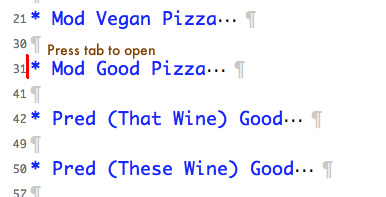 -Place cursor to the left and click tab to open it. - -2) You get a list of contexts for the test case. Keep the cursor where it was if you want to open everything at the same time. Alternatively, scroll down to one of the contexts and press tab there, if you only want to open one. -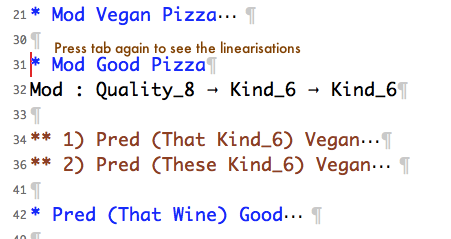 - -3) Now you can read the linearisations. -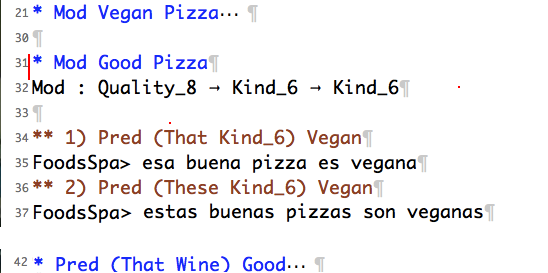 - -If you want to close the test case, just press tab again, keeping the -cursor where it's been all the time (line 31 in the pictures). - -## Less common use cases - -The topics here require some more obscure GF-fu. No need to worry if -the terms are not familiar to you. - - -### Empty or always identical fields: `-e`, `-q` - -Information about the fields: always empty, or always equal to each -other. Example of empty fields: - -``` -> gftest -g Lang -l Dut -e -* Empty fields: -==> Ant: s - -==> Pol: s - -==> Temp: s - -==> Tense: s - -==> V: particle, prefix -``` - -The categories `Ant`, `Pol`, `Temp` and `Tense` are as expected empty; -there's no string to be added to the sentences, just a parameter that -*chooses* the right forms of the clause. - -`V` having empty fields `particle` and `prefix` is in this case just -an artefact of a small lexicon: we happen to have no intransitive -verbs with a particle or prefix in the core 300-word vocabulary. But a -grammarian would know that it's still relevant to keep those fields, -because in some bigger application such a verb may show up. - -On the other hand, if some other field is always empty, it might be a -hint for the grammarian to remove it altogether. - -Example of equal fields: - -``` -> gftest -g Lang -l Dut -q -* Equal fields: -==> RCl: -s Pres Simul Pos Utr Pl -s Pres Simul Pos Neutr Pl - -==> RCl: -s Pres Simul Neg Utr Pl -s Pres Simul Neg Neutr Pl - -==> RCl: -s Pres Anter Pos Utr Pl -s Pres Anter Pos Neutr Pl - -==> RCl: -s Pres Anter Neg Utr Pl -s Pres Anter Neg Neutr Pl - -==> RCl: -s Past Simul Pos Utr Pl -s Past Simul Pos Neutr Pl -… -``` - -Here we can see that in relative clauses, gender does not seem to play -any role in plural. This could be a hint for the grammarian to make a -leaner parameter type, e.g. `param RClAgr = SgAgr <everything incl. gender> | PlAgr <no gender here>`. - - -### Unused fields: `-u` - -These fields are not empty, but they are never used in the top -category. The top category can be specified by `-s`, otherwise it is -the default start category of the grammar. - -Note that if you give a start category from very low, such as `Adv`, -you get a whole lot of categories and fields that naturally have no -way of ever making it into an adverb. So this is mostly meaningful to -use for the start category. - - -### Erased trees: `-r` - -Show trees that are erased in some function, i.e. a function `F : A -> B -> C` has arguments A and B, but doesn't use one of them in the resulting tree of type C. This is usually a bug. - -Example: - - - -``` -> gftest -g Lang -l "Dut Eng" -r - -* Erased trees: - -** RelCl (ExistNP something_NP) : RCl -- Tree: AdvS (PrepNP with_Prep (RelNP (UsePron it_Pron) (UseRCl (TTAnt TPres ASimul) PPos (RelCl (ExistNP something_NP))))) (UseCl (TTAnt TPres ASimul) PPos (ExistNP something_NP)) -- Lin: ermee is er iets -- Trans: with it, such that there is something, there is something - -** write_V2 : V2 -- Tree: AdvS (PrepNP with_Prep (PPartNP (UsePron it_Pron) write_V2)) (UseCl (TTAnt TPres ASimul) PPos (ExistNP something_NP)) -- Lin: ermee is er iets -- Trans: with it written there is something -``` - -In the first result, an argument of type `RCl` is missing in the tree constructed by `RelNP`, and in the second result, the argument `write_V2` is missing in the tree constructed by `PPartNP`. In both cases, the English linearisation contains all the arguments, but in the Dutch one they are missing. (This bug is already fixed, just showing it here to demonstrate the feature.) - -## Detailed information about the grammar - -### Debug information: `-d` - -When combined with `-f`, `-c` or `-t`, two things happen: - -1) The trees are linearised using `tabularLinearize`, which shows the -inflection table of all forms. -2) You can see traces of pruning that happens in testing functions: -contexts that are common to several concrete categories are put under -a separate test case. - -When combined with `--show-cats`, also the concrete categories are -shown. - -### --show-cats - -Shows the categories in the grammar. With `--debug`/`-d`, shows also -concrete categories. - -Example: - -``` -> gftest -g Foods -l Spa --show-cats -d - -* Categories in the grammar: -Comment - Compiles to concrete category 0 -Item - Compiles to concrete categories 1—4 -Kind - Compiles to concrete categories 5—6 -Quality - Compiles to concrete categories 7—8 -Question - Compiles to concrete category 9 -``` - -### --show-funs - -Shows the functions in the grammar. (Nothing fancy happens with other flags.) - - -### --show-coercions - -First I'll explain what *coercions* are, then why it may be -interesting to show them. Let's take a Spanish Foods grammar, and -consider the category `Quality`, e.g. `Good` and `Vegan`. -`Good` "bueno/buena/buenos/buenas" goes before the noun it modifies, -whereas `Vegan` "vegano/vegana/…" goes after, so these will become different -*concrete categories* in the PGF: `Quality_before` and -`Quality_after`. (In reality, they are something like `Quality_7` and -`Quality_8` though.) - -Now, this difference is meaningful only when the adjective is modifying -the noun: "la buena pizza" vs. "la pizza vegana". But when the -adjective is in a predicative position, they both behave the same: -"la pizza es buena" and "la pizza es vegana". For this, the grammar -creates a *coercion*: both `Quality_before` and `Quality_after` may be -treated as `Quality_whatever`. To save some redundant work, this coercion `Quality_whatever` -appears in the type of predicative function, whereas the -modification function has to be split into two different functions, -one taking `Quality_before` and other `Quality_after`. - -Now you know what coercions are, this is how it looks like in the program: - -``` -> gftest -g Foods -l Spa --show-coercions -* Coercions in the grammar: -Quality_7--->_11 -Quality_8--->_11 -``` - -(Just mentally replace 7 with `before`, 8 with `after` and 11 with `whatever`.) - -### --show-contexts - -Show contexts for a given concrete category, given as an FId -(i.e. Int). The concrete category may be a coercion or a normal -category. By combining with [`-s`](#start-category-for-context--s), -you can change the start category of the context. - -(You can get a list of all concrete categories by pairing `--show-cats` -with `--debug`: see [`--show-cats`](#--show-cats).) - -Examples: - -* First, find out some concrete categories: - -``` - > gftest -g Foods -l Spa --show-cats -d - … - Quality - Compiles to concrete categories 7—8 - … -``` - -* Then, list the contexts for some of them, say `Quality_7`: - -``` - > gftest -g Foods -l Spa --show-contexts 7 - - Pred (That (Mod ∅ Wine)) Vegan - Pred (That Wine) ∅ - Pred (These (Mod ∅ Wine)) Vegan - Pred (These Wine) ∅ - Pred (That (Mod ∅ Pizza)) Vegan - Pred (That Pizza) ∅ - Pred (These (Mod ∅ Pizza)) Vegan - Pred (These Pizza) ∅ -``` - -* Check out from [`--show-coercions`](#--show-coercions) how to find -coercions, and you can try `--show-contexts` with them: - -``` - > gftest -g Foods -l Spa --show-contexts 11 - - Pred (That Wine) ∅ - Pred (These Wine) ∅ - Pred (That Pizza) ∅ - Pred (These Pizza) ∅ -``` - -### --count-trees - -Number of trees up to given size. Gives a number how many trees, and a -couple of examples from the highest size. Examples: - -``` -> gftest -g TestLang -l Eng --count-trees 10 -There are 675312 trees up to size 10, and 624512 of exactly size 10. -For example: -* AdvS today_Adv (UseCl (TTAnt TPres ASimul) PPos (ExistNP (UsePron i_Pron))) -* UseCl (TTAnt TCond AAnter) PNeg (PredVP (SelfNP (UsePron they_Pron)) UseCopula) -``` - -This counts the number of trees in the start category. You can also -specify a category: - -``` -> gftest -g TestLang -l Eng --count-trees 4 -s Adv -There are 2409 trees up to size 4, and 2163 of exactly size 4. -For example: -* AdAdv very_AdA (PositAdvAdj young_A) -* PrepNP above_Prep (UsePron they_Pron) -``` - -### --funs-of-arity - -Show all functions of given arity (not up to). - -Example: - -``` -> gftest -g Phrasebook --funs-of-arity 3 -* Functions in the grammar of arity 3: -ADoVerbPhrasePlace -AModVerbPhrase -HowFarFromBy -QWhereModVerbPhrase -``` +Development moved to https://github.com/GrammaticalFramework/gftest |